
The GEO industry is growing rapidly. There are now dozens of tools that promise to measure your "ranking in AI", score your content on how well AI understands it, and tell you what adjustments you need to make to get recommended more often. I recently saw that there are more than 140 LLM prompt tracking tools, some with really serious funding behind them, many not. In addition, more and more traditional SEO tools are also including it in their service. Kortom, er is genoeg te kiezen.
But there is also serious criticism of the usefulness of prompt tracking. Rand Fishkin did earlier this yearthorough researchto how consistent AI tools are when recommending brands. His finding: AI almost never returns the same list twice, less than once in a hundred attempts. What exactly are you tracking? David McSweeneyanalyzedthe most popular GEO tactics and concluded that they are largely SEO advice that has been given a new look. Andrecent researchshowed that with a smart sample of prompts you can save 85% of the monitoring effort without sacrificing insight.
All good arguments. And we largely agree. But there is a blind spot in the criticism itself. And that blind spot runs deeper than the problem the critics point to.
The industry uses different names: GEO, AEO, LLMO. They always mean the same thing: being recommended by AI search platforms. We prefer to use the term AI Search, because it comes closest to practice. But the discussion we are having here applies to all those terms.
The industry is asking the wrong question
Whether you're selling a GEO tool or criticizing the industry, the discussion almost always revolves around the same central question. How do you ensure that your content is more readable for AI? How do you structure your pages? How do you optimize schema markup? How do you measure your visibility in AI responses?
That's not wrong. It helps. But it is incomplete, and that incompleteness costs more than most marketers realize.
How do I ensure that I am recommended when my target group searches for what I have to offer? No matter where they look.
The question that really matters is much simpler: How do I get recommended when my target audience searches for what I have to offer? Whether that is via ChatGPT, via Google, via a Reddit thread, on social media, or via a colleague who recommends a tool in a Slack group.
AI is a new channel in that story. Not the whole story. And anyone who only optimizes for that channel misses the foundation on which all visibility ultimately rests.
What the data says: 85% comes from external sources
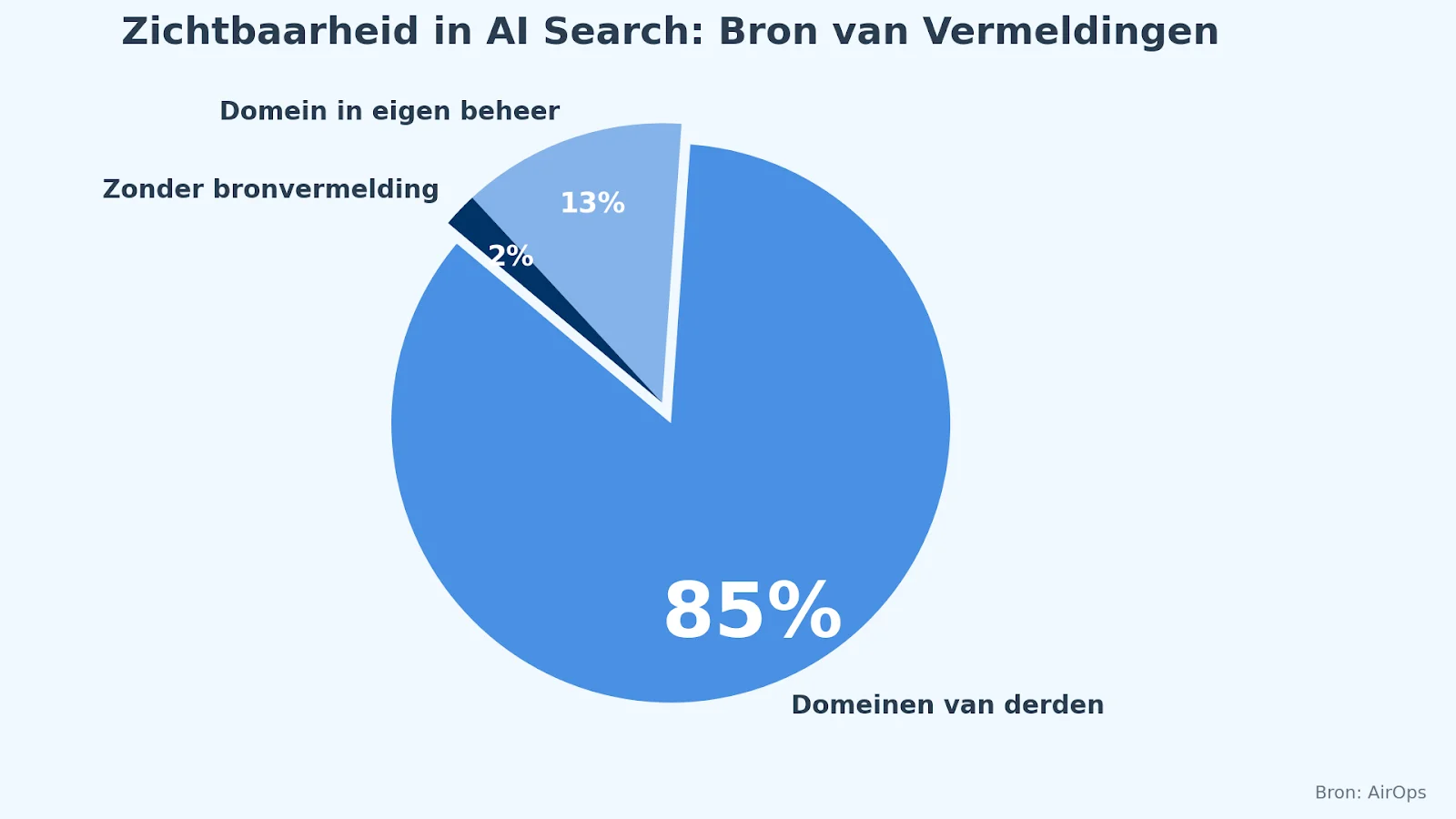
Approximately 85% of brand mentions in AI responses come from external sourcesAirOps research. Reviews, discussions, comparisons, articles, forums. Only a small part comes from your own website.
LLMs do not recommend what is best optimized. They repeat what they encounter everywhere. They have learned from the Internet: which brands are mentioned in what context, what is consistently said about a product or service, which names keep popping up when people write about a specific problem or need.
A brand is recommended by AI because it repeatedly shows up where potential customers collect information. In the Reddit thread about your industry. In the comparison on an independent site. In the review someone wrote six months ago. In the trade magazine article that a journalist made.
These are the sources from which LLMs draw. Those who are not present there simply have less to optimize, no matter how much you spend on tools.
AI visibility as an outcome
Amanda Natividad from SparkToro recently conducted a simple but very interestingexperimentout. She asked eight mothers with children of the same age to look for a basketball league for their child. All eight did it completely differently. Different platforms, different wording, different context. Same intention, completely different approach.
Her conclusion: people no longer search, they ask. The wording varies greatly, but AI tools recognize the underlying intent and return to a relatively consistent set of marks. Not because those brands are technically the best optimized, but because they are prominently present in the corpus from which the model draws. And then she also wrote something very interesting about SparkToro's own AI visibility: it was not a strategy, but an outcome of years of focus on content, distribution and PR. Not something to immediately optimize on, but something that followed as a result of a serious presence in the conversations that their market is having.
That's exactly the point. The brands that are best recommended by AI are rarely the brands that have worked the hardest on AI optimization. They are the brands that have had the longest and most consistent presence in the broader conversation about their market. AI visibility is the outcome of this, not the starting point.
The value of LLM tracking tools
That doesn't mean tracking tools have no value. Certainly, these tools can give you insight into how your brand is perceived in AI responses, where your visibility is growing or declining, and how you stack up against competitors. For companies that work systematically with this, this is useful information that you can take action on.This case studyfrom Josh Grant about Webflow, for example, clearly shows what this can look like at its best.
But for most companies, an expensive LLM tracking subscription is not the right first step, especially if the foundation is not yet in place. First make sure your SEO basics are in order. Then ask yourself honestly whether you are willing to invest time and attention in a relevant presence outside your own website: in the conversations, communities and publications where your target group orientates itself. If that answer is no, then an LLM tracking subscription makes little sense. The outcome is then simply of no use to you, because measuring without the willingness to do something with it does not change your position.
AI Search as a learning tool
Plus, there's another way AI Search analytics is really valuable, and it's rarely mentioned. Not as an optimization instrument, but as a learning instrument.
See what AI tools say when your target group searches for what you offer. Which pain points keep coming back? What questions are asked that you have not yet answered? What needs do people mention in a way that you would never have formulated yourself? Where are competitors leaving something that you can fill?
These are valuable insights. But the reflex of many tools and agencies is to use those insights in the wrong way. Example: a tool signals that Reddit is an important source in your market, and the conclusion becomes: start using Reddit. What that means in practice: fake accounts, self-promotion packaged as an organic recommendation, sponsored threads that look like real discussions. They have a nice term for this in English: astroturfing. And it might work for a while, until Reddit users see through you, which they almost always do, and your reputation is hit harder than your visibility was ever improved. Moreover, it is only a matter of time before LLMs realize that you are the one who writes so positively about themselves, and that opinion no longer has any value.

The correct conclusion from that same insight is a different one. Reddit is relevant in your market, so what are people there really saying about the problem you're solving? Where are they frustrated? What don't they understand? What are they missing in the current offering? These are insights that you can use to improve: in your product, your communication, your positioning, your offering. And if you actually solve the problem discussed, add value with your knowledge and skills. Be transparent. And be radically honest, also about when you are not the right party.
A lot of “AI SEO” boils down to massive content generation with limited human editing, leading to generic, overlapping, and sometimes erroneous content that undermines rather than strengthens your authority. Do not use the insights you gain to spam the internetAI-generatedarticles or an obviously biased story that is not based on the truth. But to learn what really concerns your market and do something with it.
That's the difference between learning and manipulating. Between acting on insight and optimizing on a metric.
What that actually means
This is not a plea to neglect your website or to throw AI optimization overboard. Make sure your content is readable, clearly structured, and that you answer the questions your target group asks. That remains relevant, for Google and for AI.
But the question you should also ask: in which places outside your own website is your solution already being talked about? What consensus about your brand and your competitors is there online? Which external sources are relevant in your market: which forums, comparison sites, communities, trade magazines/sites, Reddit or YouTube? Are you also there with something worth quoting?

And more broadly: do you already deserve the recommendation, in the places where your target group orientates itself, or are you just wondering how to arrive at an AI answer? These are the questions that the industry often does not ask. Not because they are unimportant, but because they are more difficult to package in a dashboard.
The honest conclusion
The GEO industry has a point: visibility in AI responses is relevant, and there are things you can do to influence that. But the critics also have a point: much of what is sold is too expensive, too complex and solves the wrong problem.
The fundamental question is not how to optimize for AI visibility, but how to build a brand worth recommending.
What both camps miss: the fundamental question is not how to optimize for AI visibility, but how to build a brand worth recommending. Also use AI Search as a mirror, not just as a playing field. Learn what concerns your market and incorporate that into what you do, not into tricks that temporarily boost your visibility. That is an older issue than AI. But AI makes the consequences more visible than ever, and rewards the brands that already took that question seriously.
The rest is optimization. And optimization only works if there is something to build on.
Do you disagree with what I'm saying here? Tell me. Serious. This discussion is far from over, and good counterarguments move us all forward. You'll find meon LinkedIn.
Do you think what we are saying here is correct? In ourAI Search Trainingwe will work on this for a day, with your own brand.