Before we dive into the changes within Google, it's worth knowing that they also announced Gemini 3.5 Flash. This is their new flagship LLM, competing with ChatGPT 5.5 Pro and Claude Opus 4.7, but significantly faster and considerably cheaper. That last point makes it ideally suited for deeper AI integration across Google, where you expect not just the right answer, but a fast one.
Google Search is shifting from an index of blue links to a proactive, 'agentic' ecosystem, to which several new elements were added today.
The way people consume information will change considerably as a result of this series of updates, which in turn directly affects how brands and organisations can be visible online. The click on the blue link to your website isn't going away tomorrow, but that link will have to compete with new AI alternatives inside the search results.
Here are the key AI integrations from Google I/O, and what they mean for your digital strategy.
The Intelligent Search Box: From keywords to context
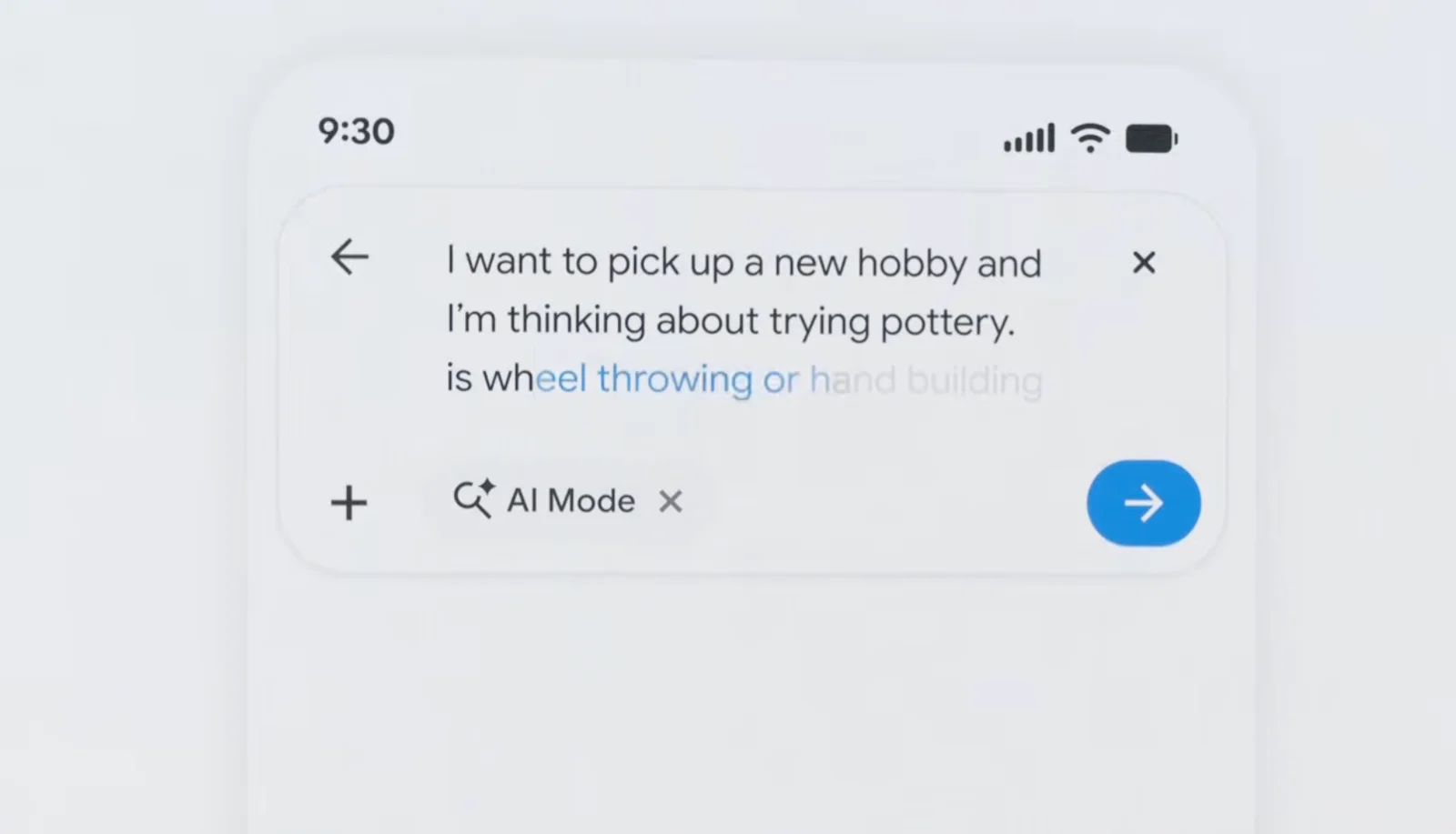
The familiar white search bar is getting a major overhaul. The new interface actively helps users formulate complex questions and effortlessly combines text, images, and video in a single query. Think of it as the next evolution of search suggestions, but directly inside your search bar.
Where consumers used to enter short, concise search terms, queries are now becoming longer and more complex. The searcher no longer types isolated keywords, but conducts an ongoing dialogue with the search engine. Google announced that Search now responds in real-time as you type, with smart additions, nuances, and proactive follow-up questions to refine the intent behind your query.
As a result, the traditional focus on flat keywords is rapidly losing its value. To stay findable online, content strategy needs to shift toward answering complex customer questions and providing deeper context. And not just on your own website, every digital space where your product or brand is being discussed needs to deliver the right input to be picked up by Google's AI results.
SEO is no longer just about keywords, but increasingly about answering complex customer questions and deeper context.
Information Agents & Agentic Booking: AI as a permanent middleman
Users will soon be able to create and manage multiple personalised AI agents directly within Search. The first step: Information Agents. Instead of a one-off search query, these agents work 24/7 in the background. They continuously scan the web (blogs, news, social media) and real-time data (shopping, finance) to proactively send users updates whenever something changes. Google's own examples include continuously monitoring the housing market or sneaker drops. This launches this summer for Google AI Pro & Ultra subscribers, initially in the US.
Alongside this, Google is rolling out Agentic Booking. Search doesn't just look for local services (restaurants, hairdressers, handymen), it shows live availability, prices, and booking links directly. In specific categories, Google's AI can even phone a business on the user's behalf to arrange an appointment.
What this means: consumers no longer visit your site daily to check for updates, their personal agent does that work in the background. On top of that, the local marketing funnel shifts entirely: if Google can call or book your business directly through Search, your online availability and data infrastructure need to be flawlessly connected. Brands need to optimise for the criteria AI agents use to measure trustworthiness.
That makes it increasingly important that your content, product feeds, and online reputation (think reviews and social mentions) are structured so that Google's 24/7 agents consistently select your brand as the best answer.
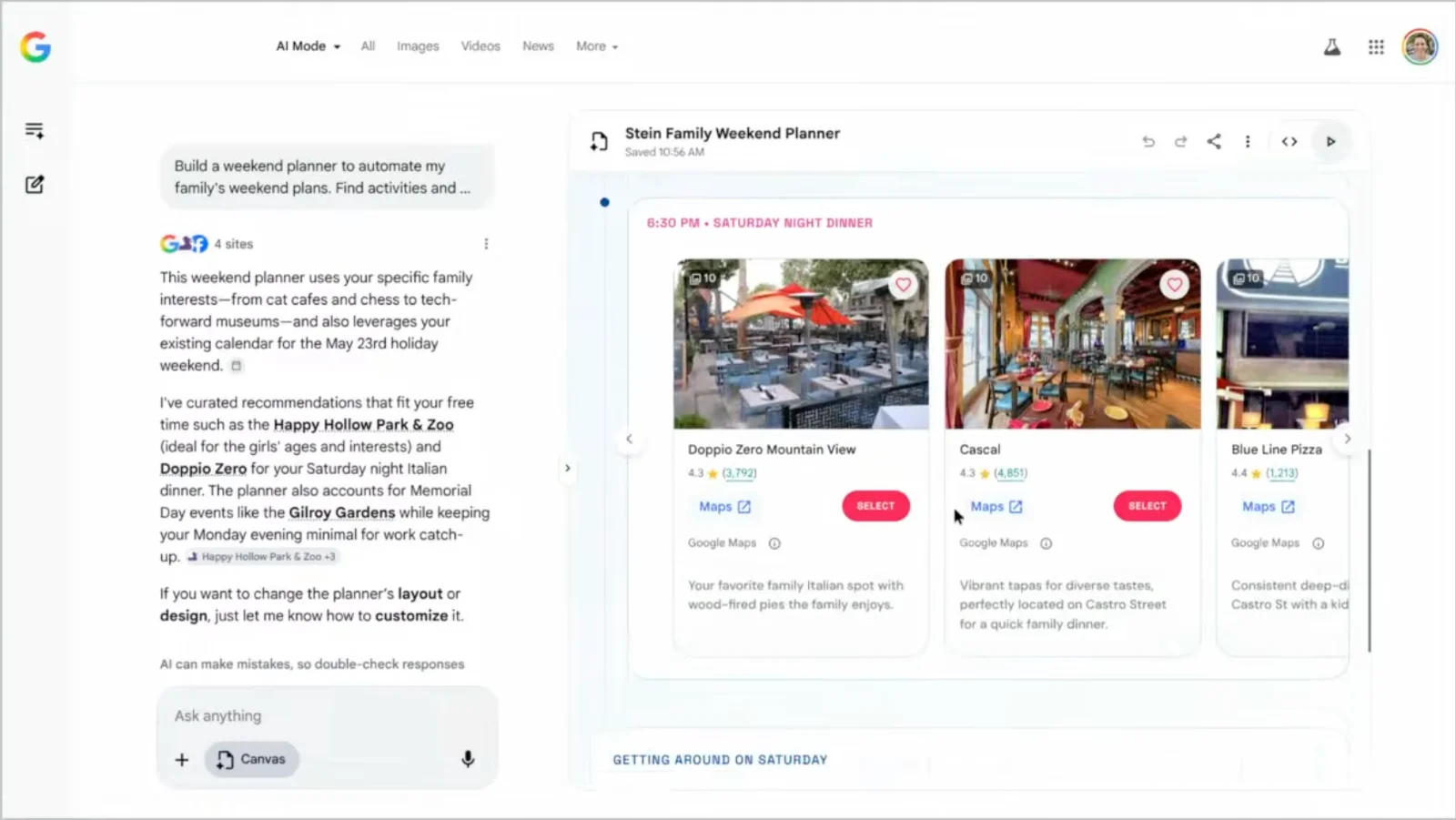
Agentic Coding & Generative UI: Search results become 'mini-apps'
I'm still genuinely curious to see how much this will move the needle in practice, but this might just be the coolest update. With the introduction of Agentic coding in Search, powered by Google Antigravity and Gemini 3.5 Flash, Google is turning the search engine into a software developer. From now on, Search builds the ideal response live and entirely on the fly, in the right format. The result is a Generative UI: tailor-made layouts with interactive visuals, tables, and simulations.
For long-running tasks (like a move or a fitness routine), Search builds a complete custom dashboard or tracker, a kind of mini-app, that the user can keep coming back to. A fitness tracker like this pulls real-time data from live maps, the weather, and reviews.
Depending on how big this becomes within the 'search results,' this goes far beyond a 'zero-click search.' Google is building an entire application around the user's task. If Google builds a tracker that draws live from 'reviews and local data,' your website is no longer the final destination, it's the supplier of raw materials.
Last but not least, 'Ask YouTube': Video becomes fully searchable
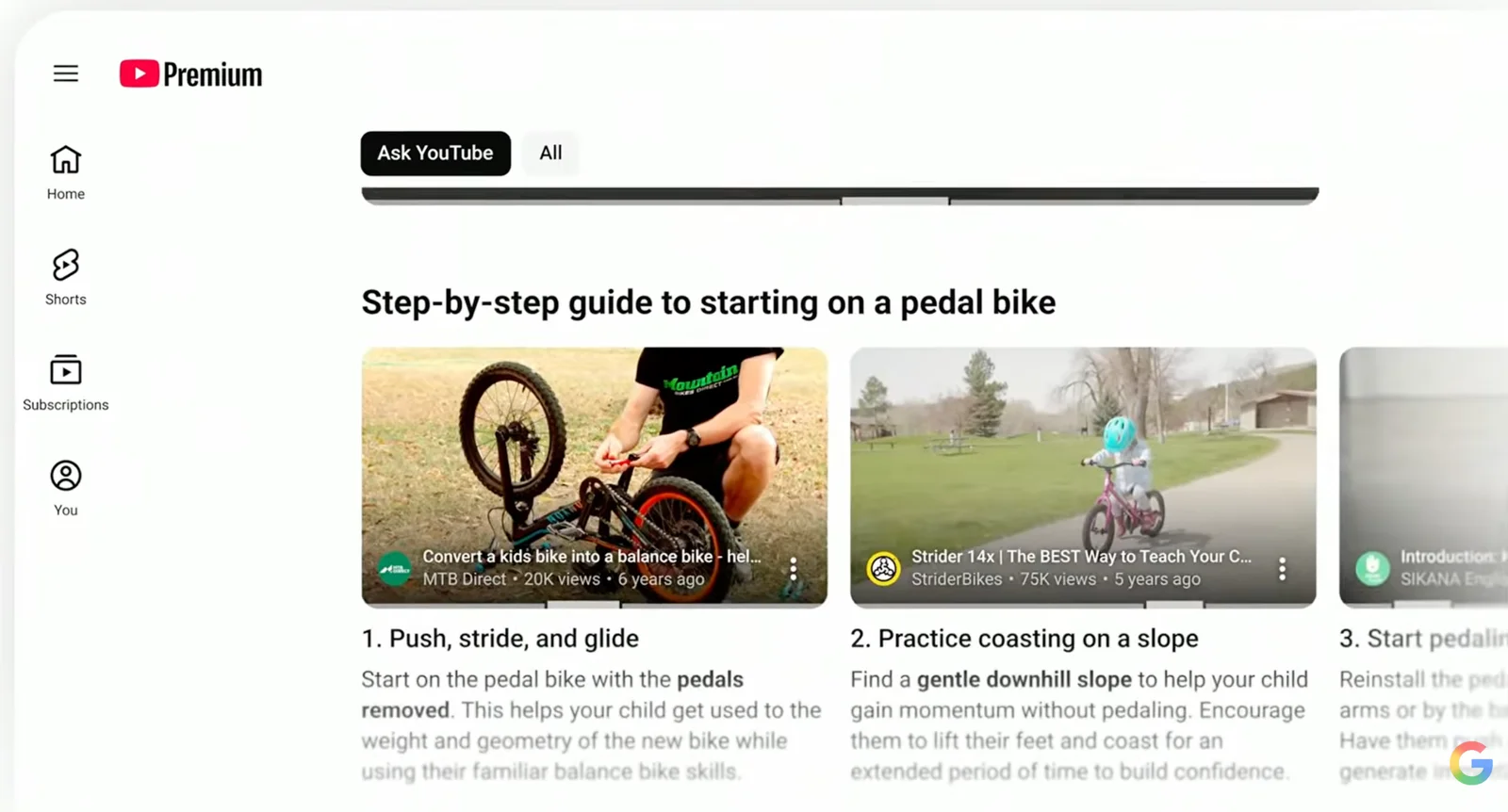
YouTube SEO is an essential part of the content strategy of any modern brand whose consumers research products before purchasing. To succeed as a brand, you've always needed to create good content and give it the right context. With the new Ask YouTube feature, that context takes on serious extra value. The AI now understands videos at chapter, frame, and audio level.
Users can ask complex questions about the contents of a video. The AI selects the right videos and jumps straight to the exact second on the timeline where the answer is given.
Video content requires a tight, logical structure and smart indexing, so the AI can 'scan' your video and serve it up as the ultimate answer.
Many of these new features will roll out in the US first, before they reach the Netherlands. For international brands, that means you need to start optimising your brand for them today. And even though it's not yet available in the Netherlands, it's wise not to wait until it lands here. The fact that AI will play an ever-larger role in search is no longer in question. How visible your brand will be is in your own hands and waiting won't help that cause.
Beyond the changes in Search, there were plenty of other announcements as well, more on those soon.