I am a marketer. I have been working in the marketing profession for fifteen years and I am developing content strategies, keyword research, writing articles, brochures and engaging social posts that convert. I dare say that I can do quite a bit of it.
In the meantime, the profession is changing rapidly. For a social media campaign, AI writes the copy, appropriate for the phase in the marketing funnel, target group, tone of voice and goal. The image or video is also optimized by AI. And to expand the company list to be targeted, AI conducts in-depth research into companies that are not in my list but do match the description. Everything in itself is better and many times faster than if I were to do it myself.
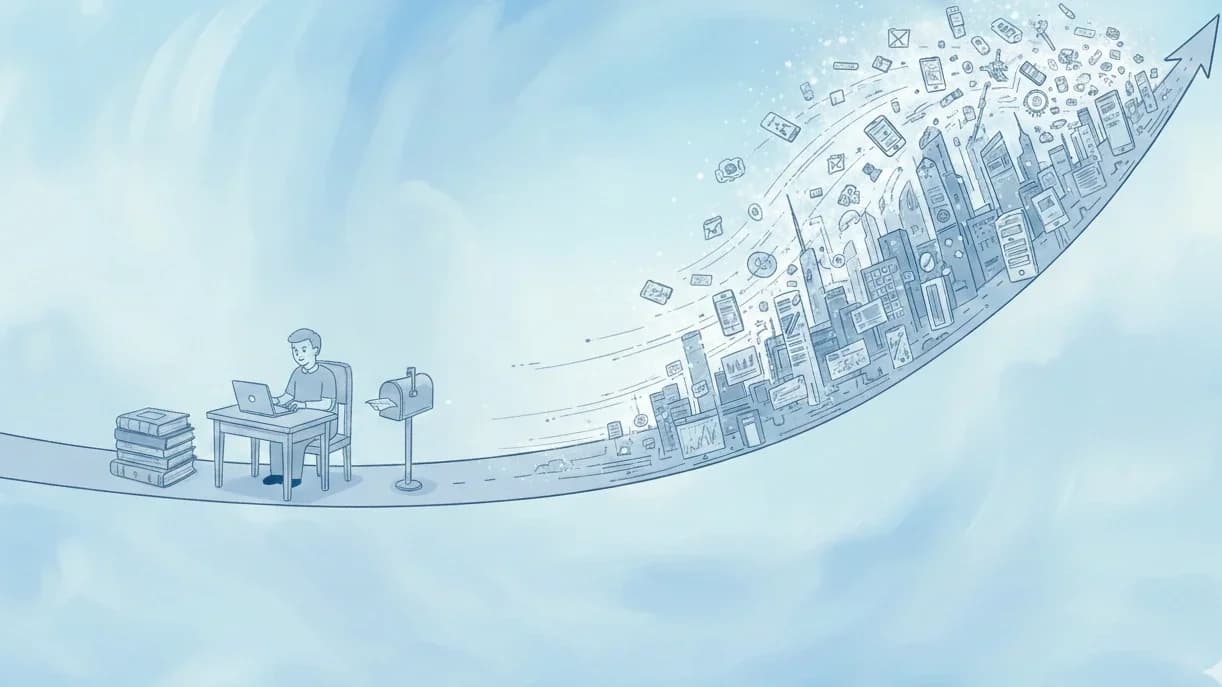
For me, we are right at the tipping point. Not because AI suddenly existed, but because it went from "useful tool" to "does large parts of my work better than I do" in a short time. And if this is happening this fast in my field, then it's happening this fast everywhere. Most people I talk to about this don't realize it yet.
That is why former colleague Peter Minkjan, who experiences this like no other, and I started Think again.
How quickly this happened
Not so long ago, AI was a chatbot to which you asked short questions. Useful for brainstorming. Good enough for a rough first version of a text that you then had to edit extensively. No more than that.
Then it went faster.
From chatting with a chatbot to agents that you can train to perform specific tasks for you. From individual answers to complete workflows. From a tool that helped with one part, to a system that took over increasingly larger parts of an entire task.
The new generation of AI models from late 2025 and early 2026 no longer does what you ask in the way you explain it. It does what you mean. AI independently conducts target group research, analyzes your campaigns, writes social media copy and structures complete content strategies. Not as an experiment, but as a daily reality.
And then you realize: I have built up fifteen years of expertise in something that a machine can now do independently.
What a difference a year makes
A year ago, without any coding experience, I built a tool that could do SEO research and link it to YouTube viewership. The system provided strategic advice on YouTube SEO. A technology that I knew from a previous job and had been developed there by developers. Without AI, this would have taken many hours of manual work and I would never have been able to create the tool. It took me days of work at the time and was only useful with expert knowledge. Today I would build the same thing in a few hours, usable by anyone.
That compression from days to hours, from hours to minutes, has not stopped. At the beginning of January I built as a hobby projectwinterkaart.comin Cursor, in a few hours. A website where people could enter their local snow depth to get an idea of national snow coverage. ChatGPT wrote the copy for my social posts. Within a week the site had more than 30,000 visitors. I can't program. Still, I built a working web application, launched it with AI-written content, prepared a radio interview with AI, and the website reached tens of thousands of people in a week.
That is not something of the future. That was last month.
From performer to conductor
What fascinates me most is how the role of humans is shifting. It started with chatting with a chatbot. That grew into working with agents and automations. And now we are coming to the point where as a human you are mainly the conductor of your orchestra of AI tools. You no longer have to be able to play everything yourself. You need to know which instruments are available, when to use them and how to coordinate them.
That is a fundamentally different skill than what most people now do every day at work. And it's a skill that is taught almost nowhere.
I'm not the only one who sees this
Earlier this week, Matt Shumer, an entrepreneur who has been running an AI startup for six years, wrote a viral article that also inspired this story:Something Big Is Happening. Matt shares a similar experience from a developer perspective. How he has complete applications built by AI, how the system tests and improves his own work, and above all, how he determines the direction. It was good to read that someone from another field describes the same shift.
Dario Amodei, the CEO of Anthropic, wrote a 20,000-word essay in late January titledThe Adolescence of Technology. His message: AI does not replace one specific profession, but functions as a general replacement for human knowledge work. He predicts that 50% of entry-level positions in office work will disappear within one to five years and warns that this will happen faster than any technological transition we have seen before.
And today there was another voice. Mustafa Suleyman, Microsoft's AI chief, said in an interview with the Financial Times that most of the tasks of accountants, lawyers and other professionals will be fully automated by AI within 12 to 18 months. Not in five years. Within a year and a half.
These are not thrill seekers. These are the people who build it. And they all tell us the same thing.
The gap that both energizes and worries us
The problem is not that AI moves fast and makes us work differently. The problem is that most people don't realize how fast things are going.
Anyone who tried ChatGPT in 2023 and wasn't impressed with it was right. That version was limited. But that was forever ago in AI times. Today's models are unrecognizable compared to six months ago. The difference between the free version and the best paid models is the difference between the first mobile phone and an iPhone 17 Pro.
Most people still base their judgment on that first mobile phone.
That gap between what people think AI can do and what it can actually do is widening every month. And that gap is dangerous. Not because AI is scary, but because people are not preparing for something that is already happening.
If you, as a marketer, entrepreneur, consultant or communications professional, do not know how to conduct target group research, analyze campaigns, write content and develop complete strategies with AI, then you are not lagging behind. Then you miss the most important thing happening in your field.
Why Think again
Peter and I set up Think again based on a simple belief: the knowledge people need to understand this is locked up in a small bubble. And that bubble mainly talks to itself.
There is no shortage of AI content online. But most of it is too technical, too superficial, or written to sell you something. We want to have an honest conversation. The conversation about what AI actually means for your daily work.
We bring our perspective from marketing, content, search and a passion for innovation and new technologies.
We do this through inspiration sessions, workshops and consultancy. Always practical, always up to date. No theory about what AI could one day be capable of, but direct applications that you can use in your work tomorrow. We don't just teach you what tools are available. We teach you to understand what is shifting, so that you can determine how you position yourself.
And yes, also the code forthinkagain.nlis written entirely by AI.
Start today
The CEOs of the world's largest tech companies tell you that the next twelve to eighteen months will change everything. The people who will get through this best are not necessarily the smartest or the most technical. It is the people who are starting to experiment now.
Take a real task from your work. Something you think: AI probably can't do that. Try it anyway. Grab the latest thinking model from Claude or ChatGPT. You will be surprised.
And if you don't know where to start, if you don't know which model to use, if you don't know how to use AI for your specific work: that's why we built Think again.
It's time to rethink how you do your work starting tomorrow.