This article is a follow-up to We built our own fully custom AI-first Workspace, CMS, CRM, social media management tool and more.
In April we wrote about how we built all of our work into a self-built operating system. As a result, we have: No Slack. No Salesforce. No Google Analytics. No Excel, no PowerPoint. No Notion, no Trello, no Buffer, no WordPress. Everything built ourselves, and everything talks to each other. We got a lot of enthusiastic responses back then, so here's another update on some developments we think are genuinely exciting.
In our previous article the story was: having everything in one place saves hassle and costs, and most importantly, because all the data lives in a single database, you can automate things that a stack of separate SaaS tools could never pull off. Even though it already ticked some of those boxes back then, it was still only the beginning of our vision.
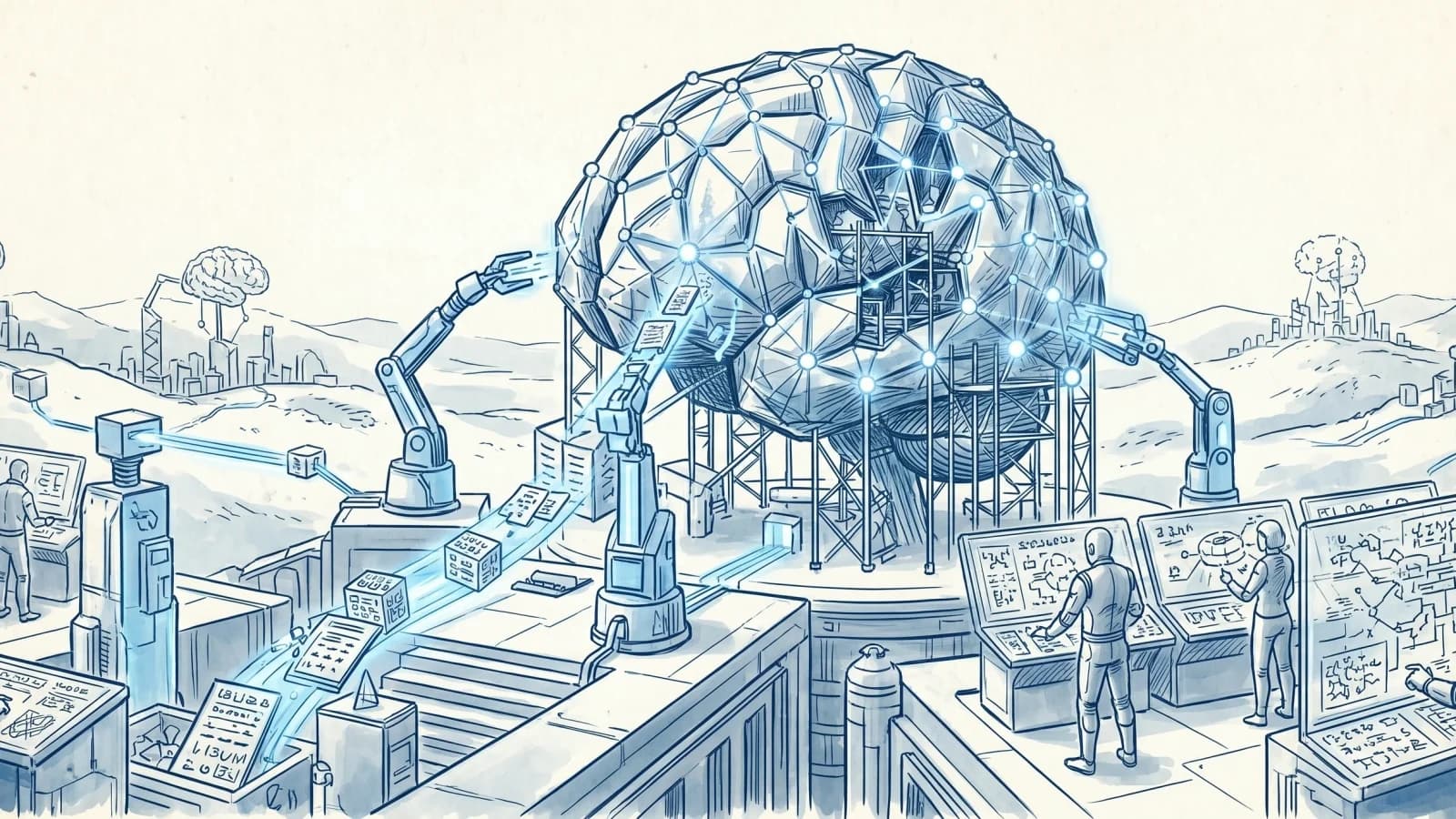
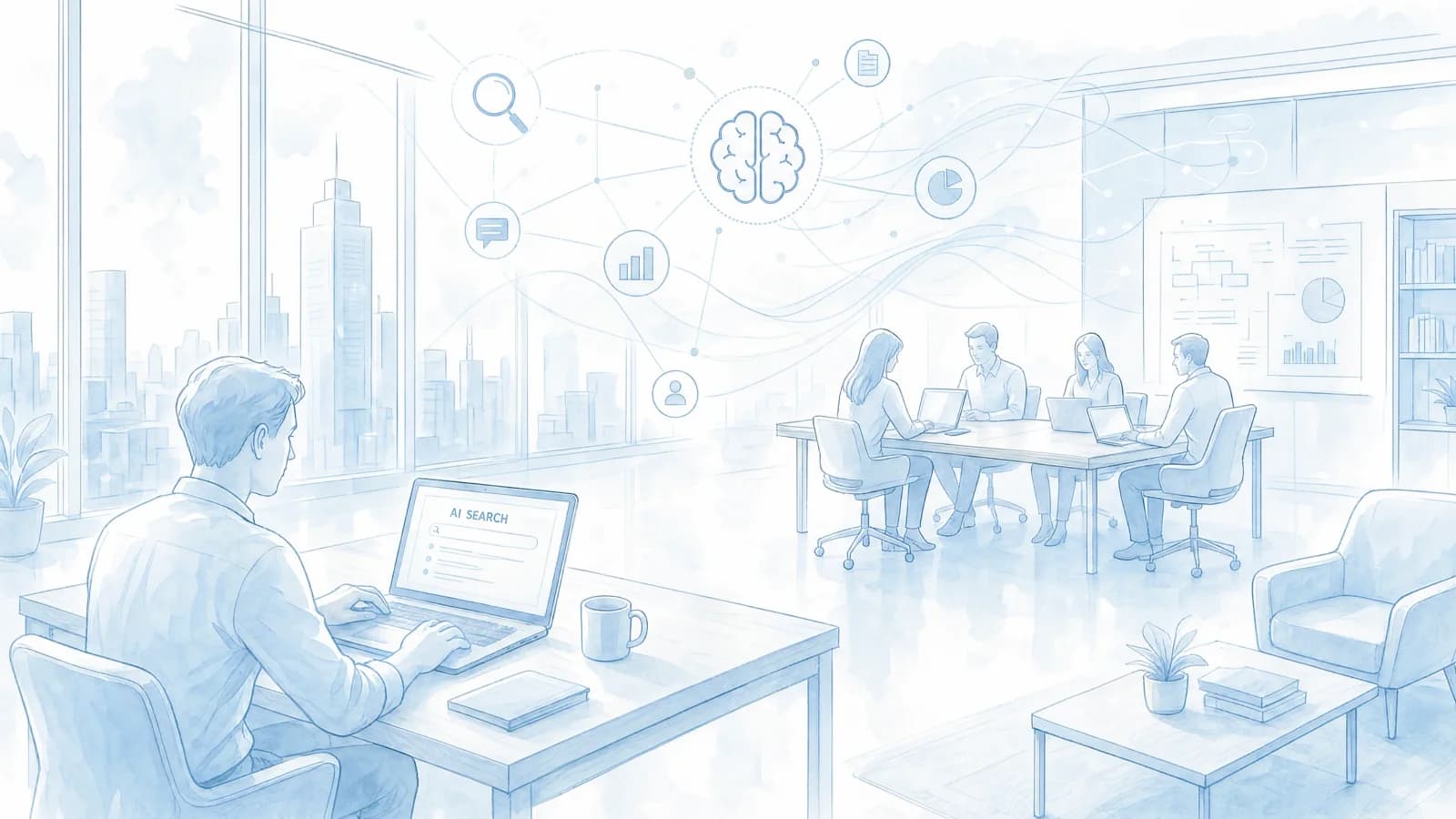
Because the interesting part isn't that everything sits in one place. I don't think many people really care about that. It's what you can then layer on top. Over the past weeks we built that layer, and it changes the way you're used to working. Our workspace is no longer an archive you search through and send messages from. It has become a brain that thinks along, remembers, and maintains its own knowledge.
To build this, we keep reading up on how other companies approach it. Recently, for example, this article (How to build an AI-first company) about the Dutch company HelloPrint went online, which is working on this in its own way.
This is how it works for us, and why we think there's a huge opportunity here to get ahead, especially for small and mid-sized businesses (SMEs), that most companies don't see yet.
From "AI in every module" to "a layer that oversees everything"
When we wrote our previous article, AI was already everywhere: suggestions for follow-ups in the CRM, a CMS that writes along, contact enrichment. All useful, but they were still isolated bits of cleverness, each within its own little screen. Just like the tools we wanted to get rid of, only now neatly under one roof.
The question that kept nagging at us, and that partly underpinned the decision to build ThinkagainOS: what if there were a single layer that looks across everything? One that doesn't see a deal as a row of fields, but as a story built from the emails, the messages, the meetings, the quotes and the invoices that are all attached to it?
That's what we built over the past month. Internally we just call it "the Brain." Inspired by the term "Company Brain" that you may have seen popping up more often lately in the AI world.
1. Summaries that keep themselves up to date
For every deal, every company, every to-do, and so on, the system now maintains a living summary. That takes you from fields someone once filled in and then forgot, to a summary that the AI model keeps current itself the moment something changes.
Open a deal and you immediately see:
where the deal stands (going well / at risk / waiting on the client / won);
the key facts and what's still outstanding;
the risks, and how heavily they weigh;
and a concrete next step, with one click to turn it into a task.
To do that, the system reads everything attached to that deal: the activities, the messages in the channel, the linked meetings, the quotes and invoices. It turns it into the story you would otherwise have had to piece together yourself across eight screens. And at the company level, task level, and so on, it does the same: one glance at a client, with all deals, contacts and outstanding invoices summarized.
A small but important detail: the system computes a kind of fingerprint of all the underlying information. If nothing changed, it doesn't generate a new summary, which saves unnecessary (and not-free) AI calls. If something did change, it refreshes automatically.
2. It's not allowed to make anything up
This is perhaps the most important choice we made, and exactly where most corporate AI experiments fall apart: hallucination (not for nothing the Dutch Van Dale dictionary's word of the year in 2025). AI that claims, with full conviction, things that aren't true. In a marketing text that's annoying. In your CRM it's dangerous.
Our solution: every hard claim the Brain makes has to point to a real source record, that specific message, that concrete invoice, that existing meeting. After that, ordinary, predictable software runs over it (not a second AI) that checks whether that source really exists. Made-up sources get thrown out before you ever see the summary.
The effect: the Brain can't lie convincingly. What you see is traceable to something that actually exists in your system. Here, trust isn't a promise on a slide. It's built into the architecture. Since we only built it recently, this is of course something we'll need to keep monitoring in the coming period, before we can trust it blindly.
3. Daan (our AI colleague) now remembers
On top of the Brain sits Daan, our built-in AI colleague. We used to call our Openclaw setup Daan. Now that that Daan is no longer around, the name has taken on a new life. Daan can access everything in the dashboard, consults the Brain, creates tasks and answers your questions, both typed and spoken. There's a live voice mode where you simply talk out loud to Daan while you keep working.
Ask "what's still open at company X?" and Daan pulls in the account brain: the open items, the risks, the recommended next step. And then turns it into a task right away, once you approve.
But the real leap, compared to just querying Daan: Daan now remembers. We built a memory layer, decisions, preferences and facts that hold across conversations. Tell Daan once how you want something handled, and you don't have to do it a second time.
4. A knowledge base that writes itself
This is the newest part, and secretly our favorite. It's inspired by an idea from AI researcher Andrej Karpathy: flip the usual relationship around. Normally, people maintain the knowledge and the AI uses it. We let the AI maintain the knowledge and we humans use it.
Concretely: the system compiles knowledge pages itself, playbooks, processes, lessons learned, by searching through your entire work environment (deals, notes, messages, the brains) and writing grounded, traceable pages out of it. With the same anti-fabrication check: every key point points to a source. And those pages feed themselves back into the system, so they're immediately findable and make the next summary smarter.
You know the problem with every company wiki: after three months it's outdated, because nobody keeps it up. When I started with Obsidian myself, based on Karpathy's digital brain, that's exactly where I ended up after a few weeks too. Our knowledge base doesn't go stale, because nobody has to maintain it. It grows along with the work and has access to all of our work.
5. A system that starts on its own
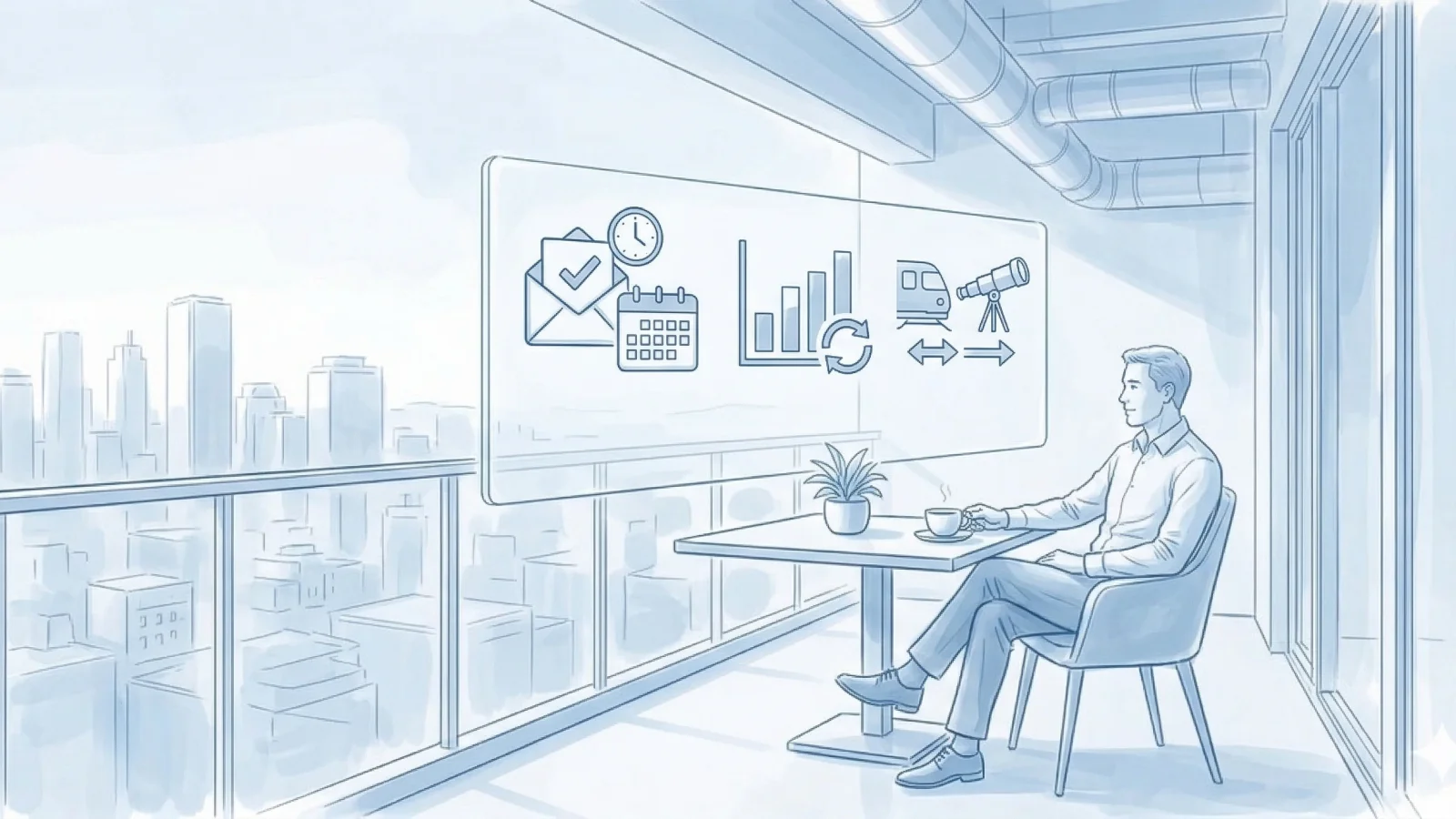
The final piece is the difference between a system you have to query and one that starts on its own. Every morning the platform puts together a briefing: your tasks, your meetings, your deals, and on top of that the signals from the Brain. The risks that need attention, the next steps that keep slipping, in order of what matters most to you.
(And yes, in the meantime the bookkeeping went in seamlessly too. The integration with Moneybird, the only software solution we deliberately didn't build ourselves but connected instead, runs both ways: companies, contacts, quotes and invoices sync automatically, and we have a live financial overview: revenue, outstanding, margin, VAT, forecast. A deal in the CRM now "knows" whether the quote has been sent and whether the invoice has been paid. Exactly the kind of context the Brain runs on.)
What this means for your business
This is the conviction behind this whole project, and the reason we're sharing it.
Large companies aren't simply going to develop a system like this for themselves. They rely on the Salesforces, Slacks, Microsofts and Googles of this world. And a migration to a self-built tool is barely realistic, which means their data will always remain spread across different platforms. On top of that, until a year ago there was the reasonable assumption that SMEs had to wait until some vendor would eventually bundle it into a standard package.
That last part is no longer true. What used to take five engineers a year, a small team now builds in months, and the individual building blocks (a good database, affordable pay-per-call AI, modern frameworks) are ready and waiting for anyone. What's scarce isn't the technology. It's the vision and coherence: daring to choose one system instead of twelve, and the discipline to lay a smart layer over the top.
And that's exactly where SMEs have an advantage they often don't see themselves:
Your data still fits into a single whole. A large corporation drowns in legacy systems and silos. An SME can still capture its entire operation in one coherent system, with a brain like this working underneath it.
You decide fast. No steering committees, no year-long procurement process. What we built these past weeks went from idea to working system in a few months, and that alongside our 'regular work.'
The margin is in context, not in manpower. A small team that treats every client as if they were the only one, because the system keeps the full story at hand, competes with players ten times its size.
So the edge isn't "we use AI," but, as Hans Scheffer also puts it, "we build AI-first." Soon everyone will use AI. The edge is: everything in one place, with a layer over it that thinks along. Separate AI tools that can't see each other's data give you ten smart islands. One system with a brain gives you a company that becomes smarter as a whole the more it does.
If you want to start on this yourself
We built this for ourselves, but the approach is no secret. A few things we learned along the way:
Start with the data, not the AI. AI is the last layer, not the first. Without unified, clean data, the smartest model has nothing to be smart with. The boring integration grind, getting everything into one system, which I personally didn't find boring at all because I couldn't stop marveling at what's possible, is the bulk of the work.
Let the system do what nobody enjoys. Keeping summaries up to date, documenting knowledge, flagging what's being left undone. Exactly the work people skip under pressure, and exactly what a brain is tireless at.
Make trust verifiable. An AI that occasionally makes something up isn't one you'll use for long. Build the checks into the technology. Everything traceable to a source.
Flip the knowledge question around. Stop asking people to maintain the wiki. Let the system write the knowledge and let the people use it.
Build for the long haul. We consistently chose the solid route over the quick hack. You don't build a brain you trust by taking shortcuts.
Don't hesitate to ask for help. We're happy to help, and after all, we've done it before.
In closing
We believe this is what will make the difference between SMEs in the years ahead. Not who talks to ChatGPT, Claude or Copilot best or most, or who has the most tools, but who understands their own work best and has a system that holds on to that understanding, sharpens it and gives it back.
And yes, this article too came largely out of the system itself. We were able to write it because we built it ourselves, and we can only credibly tell clients what AI does to their work if we do it ourselves every day.
We built it for ourselves. But the opportunity is open to everyone. Want a demo sometime? Just send us a message.