The problem with your current "knowledge system"
Where is your collected knowledge sitting right now? In my case: Google Drive, Apple Notes, folders on the desktop, iCloud, Downloads, and plenty of other places. You know you've saved valuable material. You just can't find it when you need it. Especially not when it's from a while back and you no longer remember where that one document lived.
This is exactly the problem Tiago Forte described in his book Building a Second Brain: an external, digital system to store, organize and reuse ideas and information. Our biological brain is not built to remember everything — it's built to think. So you offload the storage to a digital system.
Nice idea. But in practice, most of us end up exactly where I just described, where it's virtually impossible to keep the thing tidy. Saving all the files, we can manage. Organizing, less so. Actually synthesizing, connecting, distilling — I don't know anyone in my circles who actually does that. Because it takes a lot of time.
And that is precisely what just got a lot easier.
The new variant: the LLM as librarian
In early April 2026, Andrej Karpathy — one of the most respected voices in AI, formerly of OpenAI and Tesla — published an idea that took off on X and GitHub. He describes how he uses LLMs to build and maintain his personal knowledge base. The gist (GitHub note) he posted alongside it has racked up more than 5,000 stars and 4,300 forks, showing just how much traction it has gotten.
The idea itself is not new — people have been trying to build personal external memories for centuries. What is new is the answer to the question that ultimately sinks every one of those systems: who does the maintenance?
The answer now: the LLM.
The difference from ChatGPT file uploads
You might be thinking: but I just upload my documents to ChatGPT, Claude or NotebookLM — isn't that the same thing?
Not quite. What most AI tools do is called RAG (Retrieval-Augmented Generation). You ask a question, the system finds relevant fragments in your documents, and generates an answer. Fine. But every time you ask a question, the system has to gather the knowledge all over again. Nothing is being built up. Ask a subtle question that has to connect five documents, and the system has to make those connections from scratch every time.
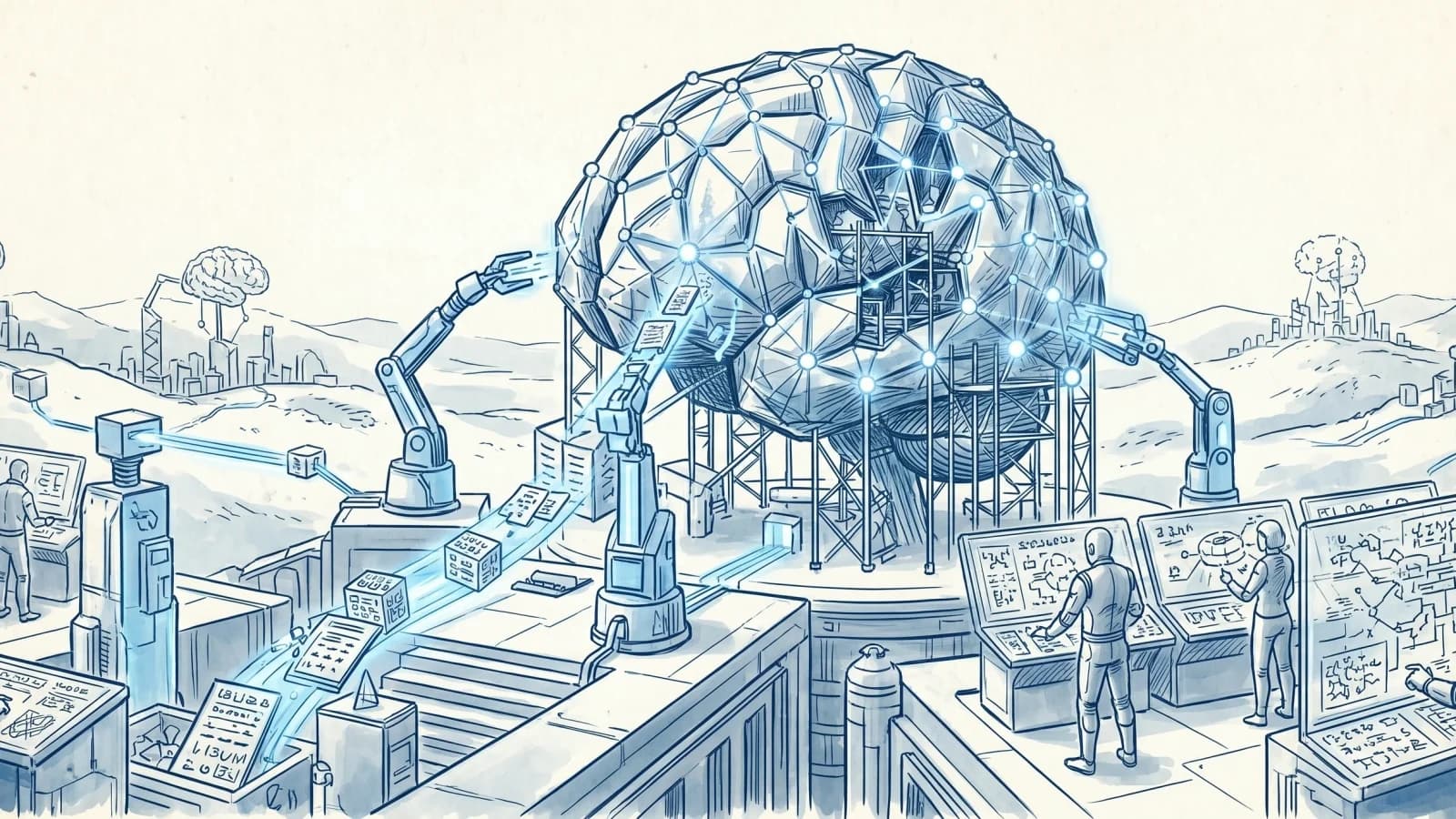
Karpathy's approach inverts this. Instead of merely retrieving at query time, you let the LLM incrementally build and maintain a persistent wiki — a structured collection of markdown files that sits between you and your raw sources. When you add a new source, the LLM doesn't just index it for later use. It reads it, extracts the core, and integrates it into the existing wiki: it updates entity pages, revises summaries, flags where new information contradicts old claims, strengthens or undermines the running synthesis.
The distinction is crucial: the wiki is a compounding artifact. The cross-references are already there. The contradictions have already been flagged. The synthesis already reflects everything you've read so far. And the wiki keeps getting richer with every source you add and every question you ask.
You almost never write in the wiki yourself. You're in charge of sourcing, exploring, and asking the right questions. The LLM does the grunt work — summarizing, cross-referencing, cataloguing, updating.
How it works: three layers
The architecture is simple and consists of three layers. Don't let the terminology scare you off — at the end of the day it's three folders on your computer.
1. Raw sources: the raw material
This is your collection of input material. Articles, reports, PDFs, meeting transcripts, podcast notes, screenshots, images. Anything you find worth keeping. This layer is immutable — the LLM reads from it but never changes anything in it. This is your single source of truth.
Practical tip: the Obsidian Web Clipper is a browser extension that converts web pages to markdown with one click. That makes collecting online sources very easy.
2. The wiki: what the LLM builds out of it
This is a folder of markdown files the LLM fully manages. Summaries per source. Pages per concept (for example "AI Search", "GEO", "Agentic AI"). Pages per entity (a person, a company, a product). An overview. A synthesis page. All cross-linked.
Two special files help you keep an overview:
index.md is your table of contents. Every page is listed, with a link and a one-line summary. The LLM updates it on every ingest. When you ask a question, it reads the index first to decide which pages are relevant. Surprisingly effective up to about a hundred sources and a few hundred pages — you don't need any fancy embedding-search infrastructure.
log.md is chronological. An append-only logbook of what happened when: which sources were ingested, which questions were asked, which maintenance passes have been done. Useful for looking back at how your thinking has evolved.
3. The schema: the rules for the LLM
A configuration file (for example CLAUDE.md if you're using Claude Code, or AGENTS.md for OpenAI Codex) in which you explain to the LLM how your wiki is structured, what the conventions are, and what process it should follow when ingesting new sources, answering questions, and maintaining the wiki. This file is the difference between a disciplined wiki maintainer and a generic chatbot that winds up making it up as it goes. You and the LLM develop this file together, as you go.
The three daily operations
In practice, you work with three verbs:
Ingest. You drop a new source into the raw/ folder and tell the LLM: process this. The LLM reads the source, discusses the key points with you, writes a summary page, updates the index, and then touches all the relevant other pages — sometimes ten to fifteen at once. Personally, it works best for me to add sources one at a time and stay involved: I read the summary, check which pages got updated, steer where needed. But you can also bulk-ingest if you want to pick up the pace.
Query. You ask questions against your wiki. "What are the key arguments across all the sources I've collected on GEO?" "Where do my sources contradict each other on agent architecture?" The LLM finds the relevant pages, reads them, and synthesizes an answer with citations. A nice detail: good answers can be filed back into the wiki as a new page. That way your own explorations also become material for future use. Nothing disappears into chat history.
Lint. Periodically, you ask the LLM to do a health check. Look for contradictions between pages. Check which claims have been superseded by newer sources. Find orphan pages with no inbound links. Flag concepts that are mentioned often but don't have their own page yet. Suggest new questions to investigate. This keeps the wiki healthy as it grows.
What you get out of it as an individual
So much for the theory. Where does this get concrete?
Research and learning. You're going to spend the next few months diving into a topic — say, the EU AI Act, or agentic workflows in B2B marketing, or voting-rights reform. You read articles, papers, reports, LinkedIn posts. Normally those vanish into a thicket of tabs and downloads. In this setup your wiki builds itself up. At the end you don't have a stack of loose notes — you have a structured picture: the main players, the key arguments, the open debates, the contradictions, and your evolving personal position.
Client or account knowledge. You work for a client (or a deal pipeline) and gradually collect information: meeting transcripts, emails, annual reports, news items, LinkedIn profiles of stakeholders. Your wiki becomes a living dossier. "What do I know about this organization so far?" gets a serious answer instead of "somewhere in my inbox, I think".
Reading a book. Sounds odd, but works great. You read a non-fiction book chapter by chapter, and have the LLM create pages for the key concepts, people and arguments per chapter. By the end, you have a companion wiki — a fan wiki for your own reading experience. Think of something like Tolkien Gateway — thousands of interlinked pages built by volunteers over years. You can now build something like that for yourself, with the LLM doing the maintenance.
Personal reflection. Journal fragments, podcast notes, quotes that struck you, reflections after conversations. Collect them in raw/. The LLM gradually builds a picture around them of who you are, what occupies you, how your thinking is developing. A mirror that can observe without bias.
Competitive intelligence, due diligence, trip prep, course notes, hobby deep-dives. Anywhere you're accumulating knowledge over time and want it organized instead of scattered.
What you get out of it as a team
This is where it gets really interesting for organizations.
Every team — marketing, sales, product, legal, HR — continuously produces knowledge. Slack threads. Meeting recordings. Campaign analyses. Customer calls. Contract changes. Product decisions. Research reports. Workshop output.
In most organizations the status quo is that this knowledge fragments. There was a Confluence at some point, a SharePoint, a Notion. But nobody maintains it. Content goes stale. New colleagues are onboarded by word of mouth because "that page isn't accurate anymore anyway". The collective intelligence of the team goes unused.
An LLM-maintained team wiki solves this from a different angle. Maintenance is no longer the bottleneck. The LLM can:
Weekly, summarize meeting recordings and integrate them into the existing client or project pages.
Pick up Slack threads about a customer and file the relevant decisions under the right page.
Flag contradictions between what gets agreed in one channel and what's written in another document.
Keep onboarding pages for new colleagues continuously up to date based on what's changing in the team.
Give someone asking a complex question ("how did we approach this client last year?") a synthesized answer with citations.
With human review in the loop where it matters. The LLM does the legwork; humans review and steer.
For marketing teams specifically, this is gold. A team wiki that continuously synthesizes customer insights, campaign learnings, content performance, competitor moves and market trends. Instead of every new campaign starting with "let's see what we did last Black Friday".
An honest note: what works and what doesn't
It's worth surfacing the debate around this idea as well, because there are serious caveats being made on X and GitHub.
It demonstrably works at personal and mid-sized scale. There are already dozens of open-source implementations from people trying and using it in practice.
Scaling to enterprise level is another story. Several critics make a fair point: an LLM that maintains a wiki of tens of thousands of pages without supervision will at some point suffer from hallucination compounding. The LLM then bases its searches on summaries it generated itself. If errors are baked into those, they reinforce over time. The realistic answer: this pattern is excellent for individuals and small teams; for larger settings you need extra structure (think: explicit source references, confidence scores, human-in-the-loop at critical checkpoints).
It does not replace a well-structured database. If you put legal documents, medical records or financial data into a markdown wiki and treat that as ground truth, you will run into problems. This system works best as a synthesis and navigation layer on top of reliable raw sources, not as a replacement for them.
You have to want to work with it. A wiki only grows if you keep adding sources and asking questions. It's not a magic box that gets smarter on its own. The LLM takes maintenance off your plate, not curation.
How do you start today?
OK, sold. But how do you start concretely, without it becoming a weekend project you never finish?
1. Pick a topic you genuinely want to go deep on. Not "all the knowledge I've ever accumulated". Instead: "what I'm learning about agentic AI over the next three months", or "everything I know about client X", or "my personal thinking on the future of marketing". A bounded topic prevents the thing from becoming a junk drawer.
2. Set up two folders. One called raw/ (raw sources), one called wiki/ (what the LLM produces). Put them somewhere local or in iCloud/Dropbox. That's the whole system. No database, no server.
3. Grab an LLM agent that can work with files. Claude Code, OpenAI Codex, Cursor, or something similar. These can read, write and edit local files. A browser-based chatbot doesn't work well for this pattern because you have to re-upload everything every time.
4. Make a simple CLAUDE.md (or AGENTS.md). Tell the LLM: (a) raw/ contains the raw sources, never change them. (b) wiki/ is your workspace. (c) Always make a summary page per new source. (d) On every ingest, update index.md and append a line to log.md. (e) Use Obsidian-style wiki links ([[page-name]]) for cross-references. You don't need more than that on day one — the rest develops as you go.
5. Install Obsidian as your viewer. Open those same folders in Obsidian. Now you can see what the LLM is building, including the graph view that shows you the structure visually. Obsidian is your "IDE"; the LLM is your "programmer"; the wiki is the "codebase".
6. Start with one source. Clip an article, drop in a PDF, paste a note. Ask the LLM: "read this, make a summary page, update the index." See what happens. Course-correct.
7. After five to ten sources: ask your first real question. "What are the three most important tensions across all the sources I've collected so far?" And feel the difference from a normal AI chat.
The deeper shift
What's happening here is bigger than a productivity hack.
Vannevar Bush wrote in 1945 about the Memex — a personal, curated knowledge store with associative trails between documents. His vision was closer to this system than to what the web ultimately became: private, actively curated, with the connections between documents as the most valuable element. What Bush could not solve was the question of who does the maintenance.
Tiago Forte named the same problem fifteen years ago in his Second Brain methodology. Capture, Organize, Distill, Express. Nice framework. But again: who actually distills? In practice, most Second Brains stall at Capture and a bit of Organize. Distill and Express get skipped because they require brain time that isn't there.
What's new is not the idea of an external memory. That's old. What's new is that maintenance costs are now effectively zero.
And that changes the economics of knowledge management. Not just for individuals who finally get the Second Brain they've been dreaming of for years. Also for teams, where a living, maintained knowledge base has always felt out of reach because nobody had the time to do it.
Your job: curate sources, collect, direct analyses, ask the right questions, think about what it all means. The LLM's job: everything else.
That is a workable division of labor — one that lets you always have all your important knowledge at hand.