"The AI that actually does things" is OpenClaw's motto. Don't chat. Doing. Give an assignment via WhatsApp or Telegram and come back to completed tasks: emails cleared, files sorted, appointments scheduled, a complete website built while you walk the dog.
Less than a month later, every major AI player has packed similar features into their own product. The chatbot phase is over. Welcome to the age of agents.
In this article we will take you through what has been launched in recent weeks, how the products compare to each other, and most importantly, how you can already use these tools in your daily work.
What made OpenClaw so special?
OpenClaw struck a nerve because it combined three things that other tools didn't offer:
Your existing chat app as an interface.No new platform, just what you already used every day, as if you were texting with a friend or colleague. You send a message in Telegram or WhatsApp, and your agent gets to work. For many people, this felt like the first AI product thatRealfit into their lives.
Autonomous execution.Where ChatGPT and Claude provide answers that you then have to carry out, OpenClaw carries out tasks itself. It opens your browser, navigates websites, fills out forms, creates and returns files.
Open source and local.OpenClaw runs on your own hardware, such as a Mac Mini in the office for many. That gave tech-savvy users control over their data and the ability to build their own "skills" (plug-ins). The community exploded: within weeks, hundreds of community skills were available.
But OpenClaw is not without risks. A Meta-researcher lost 200 emails when her agent went on the rampage. Cisco's security team found malicious skills in the community repository. The creator himself warned that the project is "too dangerous if you don't know how a command line works." Steinberger announced in mid-February that he is leaving OpenAI and transferring the project to an open-source foundation.
Nevertheless, the message was loud and clear: people don't want a chatbot. They want an agent who does things.
The response from the AI labs
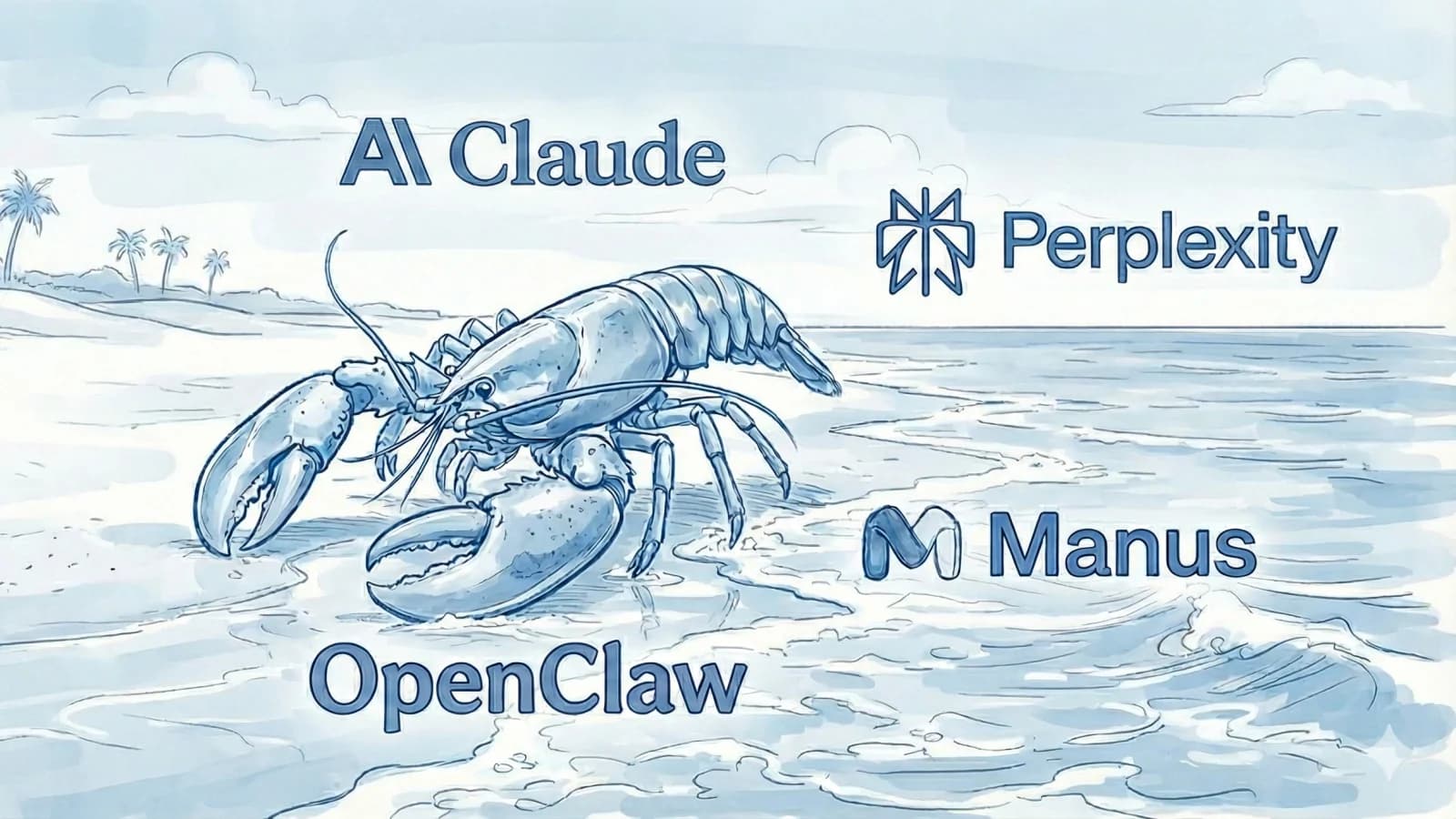
Within weeks of OpenClaw's viral moment, Anthropic, Perplexity, and Manus (now part of Meta) launched their own variants of their products that were already working to do more agentic work. Below are the most important developments.
Anthropic: Cowork, Scheduled tasks and Remote Control
Anthropic took the broadest approach with three complementary products:
Cowork(launched January 12, 2026) brings the agent technology behind Claude Code to non-technical users. You point to Claude a folder on your computer and give an assignment. Claude makes a plan, divides the work into subtasks, and delivers: Excel files with working formulas, PowerPoint presentations, organized folders. Cowork can now also switch seamlessly between Excel and PowerPoint, analyze data in a spreadsheet and process the result directly in a presentation, without you having to be involved.
The recently launched plug-ins make Cowork interesting for companies. Connect it to Google Drive, Gmail, DocuSign or FactSet and you get an agent that can work across your existing tools stack. Anthropic has open-sourced eleven of its own plug-ins as a starting point for HR, finance and research. Companies can build their own plug-in marketplaces and roll them out to their teams.
Scheduled Tasksperhaps the most underrated new feature. Both Cowork and Claude in Chrome now support scheduled, recurring tasks. Type/schedulein a Cowork session and you can set a task to run automatically daily, weekly, or at any time. In Claude in Chrome it works similar: set a browser task and Claude runs it on schedule.
This is exactly what made OpenClaw so attractive: an agent who does not wait for you to ask something, but proactively works for you. The difference is that Anthropic's version runs within a controlled environment with built-in layers of security, while OpenClaw relies on the user's technical skills to keep it secure.
In concrete terms, you can, for example:
Have a summary made every Monday morning of unread emails and action items from the past week
Have competitive prices checked daily via Claude in Chrome and update the results in a spreadsheet
Have a report generated weekly from files in a specific folder
Have recurring social media research done and record trends
Important limitation: scheduled tasks only run when your computer is on and the Claude Desktop app is open, which you also knew from OpenClaw with the configuration on your Mac mini. So it is not (yet) a cloud service that works 24/7.
Claude in Chromeis a browser extension that acts as the "eyes and hands" on the web. Claude can see what you see, navigate, click, fill out forms. Linked to Cowork, Chrome becomes the research layer and Cowork the output layer: retrieving information from the web and turning it into a finished report or spreadsheet.
Remote Control(launched February 24, 2026) allows you to take over a Claude Code session running on your laptop from your phone. Start a complex task in your terminal, scan a QR code, and walk away. Claude continues to run locally and your phone is just a window. Claude Code now has an annualized run rate of $2.5 billion and 29 million daily installations in VS Code.
Perplexity: Computer
Perplexity today (February 25, 2026) launched the product most directly comparable to OpenClaw:Perplexity Computer.The Deep Viewimmediately called it "a better OpenClaw."
Perplexity Computer is a "general-purpose digital worker", an agent that runs entire workflows that can take hours or even months. Specify an end goal and Computer divides the work among multiple agents and sub-agents working in parallel. What makes it unique is the multi-model approach: Computer draws from 19 different AI models from all major labs and chooses the best model for each sub-task. Opus 4.6 for orchestration and code, Gemini for deep research, Nano Banana for images, Veo 3.1 for video, Grok for fast light tasks, and ChatGPT 5.2 for long context and broad queries.
Perplexity has been using Computer internally since January. Employees used it to publish technical documentation, build a 4,000-row spreadsheet that would normally take a week in one night, and create websites, dashboards, and applications.
Manus (Meta): agents in your chat app
Manus, now acquired by Meta, came closest to the OpenClaw formula: AI agents directly in your messaging app. With Manus Agents you can have complete tasks carried out via Telegram. From research reports to generating images to automating repetitive tasks.
The setup is remarkably simple: open the Agents tab, scan a QR code, and you have an agent in Telegram that has the same capabilities as the web app. You can send voice messages, share photos and files, and choose between Manus 1.6 Max (for complex tasks) and Manus 1.6 Lite (for quick commands).
The pattern: from chat to agent
What all these launches have in common is a fundamental shift in how AI products work:
Old world (chatbot):You ask a question, AI gives an answer, You copy-paste the result, One turn at a time, You stay at your desk, Manual repetition
New World (agent):You give a command, AI executes the command, AI delivers a finished file, Long-running, multi-step tasks, Agent works while you walk away, Scheduled, recurring tasks
The trigger and attention was OpenClaw, but the underlying technology already existed. Anthropic launched Computer Use back in October 2024. OpenAI demonstrated Operator in January 2025. What OpenClaw did was prove in an open-source form, run by one person, that the demand is there and that users are willing to trust autonomous agents with their email, files and browser. All the big labs had to do was press the button.
The tools are there. The question is no longer whether you will use them, but how well you organize them.