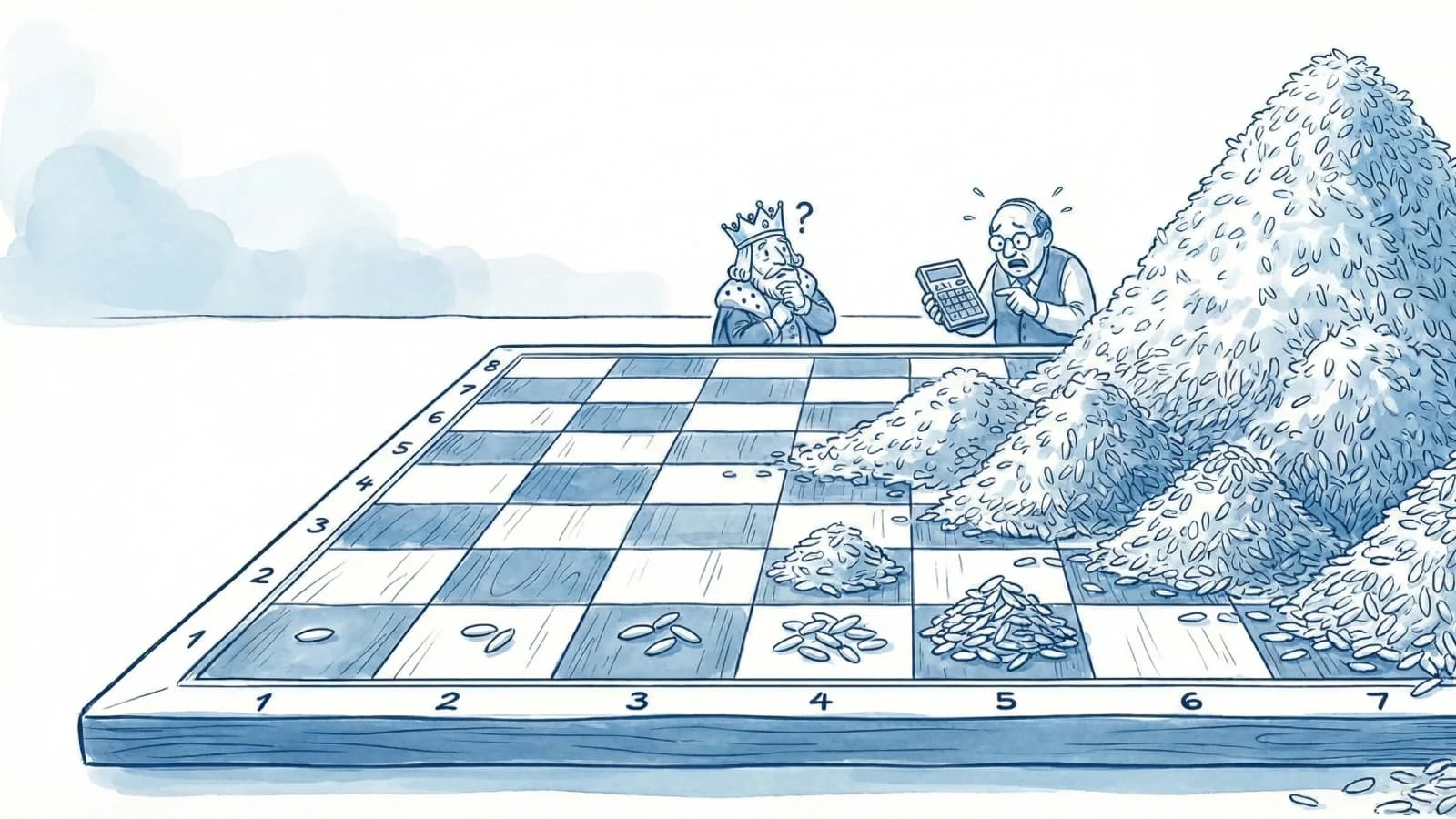
There is an old story about the inventor of chess. In return, he asks the king for a modest favor: place one grain of rice on the first square, two on the second, four on the third, and so on. Double each field.
The king laughs. What a humble request for such a brilliant invention. But then his treasurer starts calculating. There are 512 grains on field 10. Still a hand. On field 20 there are more than a million. On space 32 halfway down the board there are more than 4 billion grains. And on field 64? Then the total is 18.4 trillion grains. Enough rice to form a mountain taller than Mount Everest. More than a thousand times the annual world production.
In some versions of the story, the inventor is rewarded for his cleverness. In other versions he loses his head. But the moral is always the same: people underestimate exponential growth. And that is exactly what is happening now with AI.
Our brain thinks in straight lines
Physicist Albert Bartlett once called it humanity's greatest shortcoming: our inability to understand the exponential function. Researchers from the University of Salzburg confirmed this in a study: people structurally underestimate exponential growth, and at the same time are overconfident in their (poor) assessment.
That makes sense. Our daily life is linear. If you take ten steps, you will be ten meters further. If you take twenty steps, you will be twenty meters further. We get that. But suppose you take 30 steps, doubling each step, then you are not 30 meters further. Then you have traveled a billion meters. Enough to circle the Earth 26 times.
Our brain evolved to hunt on the savannah, not to calculate doublings.
One month in February 2026
Do you want to know what exponential growth looks like in practice? Look at what was launched in February 2026 alone:
February 5— Claude Opus 4.6 (Anthropic), GPT-5.3-Codex (OpenAI) and Kling 3.0 (4K AI video with audio). Three major launches on the same day.
February 10— RynnBrain, AI for robotics and the physical world.
February 11— GLM-5, a massive open-source model with strong reasoning skills.
February 12— Gemini 3 Deep Think (Google), MiniMax M2.5 and Seedance 2.0 (realistic 1080p text-to-video). Three more in one day.
February 16— Qwen 3.5, a lower-cost agent-centric model.
February 17— Claude Sonnet 4.6 and the Fujitsu AI Dev Platform that automates complete software development.
February 18— Google Lyria 3, AI that turns text, images or video into complete music fragments with lyrics.
February 19— Gemini 3.1 Pro with better agents and longer context.
February 21— Grok 4.20 with stronger reasoning.
February 24— Claude Cowork, focused on workflow and execution.
February 25— Perplexity Computer AI, which can independently operate your computer.
February 26— Nano Banana 2, faster and sharper.
That's at least eighteen major AI releases in 22 days. From different companies launching on the same day, to AI that takes over your computer, composes music, or writes complete software for you. And this is only February. One month.
The numbers behind the acceleration
What makes this avalanche of releases possible? Multiple exponential curves rising simultaneously and reinforcing each other.
Computing power doubles every five months.The amount of compute used to train AI models has increased by a factor of 350 million in the past decade. Until recently, AI computing power doubled every 20 months. Now it is every six months. We're not just accelerating, we're accelerating.
Costs drop exponentially.The cost to deliver the same AI performance as GPT-3.5 has fallen by a factor of 280 between the end of 2022 and the end of 2024. What cost thousands of euros two years ago now costs a few cents. That's why so many new players can launch in such a short time frame.
The AI market is growing explosively.The global AI market is estimated to be around $375 billion in 2026 and growing towards $3.5 trillion by 2033, an annual growth rate of more than 30%. Nvidia, the company that supplies the chips behind this revolution, is now the most valuable company in the world with a market value of around $4.5 trillion. By comparison, when ChatGPT launched in late 2022, it was $345 billion. Worth more than ten times as much in three years.
Investments explode.Big Tech is expected to invest more than $650 billion in AI infrastructure by 2026. Yesterday, Nvidia reported quarterly revenue of $68 billion, almost three-quarters of which came from data centers. Every dollar spent on AI generates $4.90 in economic value, according to IDC.
From niche to everything, in five years
To understand how quickly this happens, it helps to rewind a bit.
In 2020, around 20% of companies experimented with AI. It was something for tech departments and researchers. GPT-3 was impressive but inaccessible. In 2022, ChatGPT launched and reached 100 million users in two months, the fastest adoption of a consumer app ever. Suddenly the whole world was talking about AI. By 2024, 78% of organizations worldwide were using AI in at least one business function. Cursor, an AI coding assistant, reached $1 billion in annual revenue, the fastest growth of a SaaS product ever. ChatGPT became the fourth most visited website in the world, after Google, YouTube and Facebook.
And now, in early 2026, several Frontier models are being launched per month. AI writes complete software, controls your computer, composes music, and independently performs complex tasks as an autonomous agent. Five years ago this was science fiction. Today is a normal Tuesday, although I often find it difficult to realize that this is now 'normal'.
The second half of the chessboard
Ray Kurzweil, futurist and engineer at Google, introduced the concept of "the second half of the chessboard." His point: on the first 32 fields the growth is already impressive, but still manageable. In the second half it becomes absurd. More than four billion times as much as the first half.
The question every organization should ask itself: which field are we in now?
If you look at the pace of February 2026, eighteen releases in 22 days, models being surpassed monthly, costs halving every few months, we appear to be entering the second half of the board. The part where the numbers add up so quickly that they defy all intuition.
What does this mean for you?
If you feel like you can no longer keep up with AI developments, that is not a personal failure. At least that's what I tell myself. It's a property of your brain that clashes with the mathematics of exponential growth. You are programmed to think linearly in a world that is changing exponentially.
That realization alone is valuable. Because it means three things:
Your current estimate is probably too conservative.What you expect AI to be able to do today in two years, it will probably be able to do in six months. Look at February: models that were state-of-the-art a month ago have now already been overtaken.
Waiting is becoming increasingly expensive.Every month that you as an organization wait to understand and apply AI, the backlog increases exponentially, not linearly. While you're still working on your 2026 AI strategy, your competitors are already building with tools that first became available last week.
You don't have to understand everything, no one does, but you do have to start.The organizations that experiment, learn and adapt now are building a lead that will soon be impossible to catch up on. In any case, the technology does not wait until you are ready for it.
The moral of the grain of rice story
That old king thought he was granting a simple request. He surveyed the first few spaces of the board and concluded that everything was not too bad. By the time he realized what was really going on, it was too late.
You don't have to be a mathematician to understand the lesson. You just have to accept that your intuition is deceiving you on this point and adjust your strategy accordingly.
The AI revolution is not happening quickly. She goes exponentially. So if you are still unsure about getting started, think again.
Think again helps marketing and communications teams understand and apply AI developments. Not from the hype, but from critical thinking and practical applicability.