Starting a company means picking a software stack. Most start-ups go for Slack, Google Workspace, a CRM, Trello — you know the drill. But coming from an AI-first mindset, where we genuinely believe almost anything can be built yourself with the right knowledge, we took a different route. Step by step, we added features and improved the ones already in place.
What we built
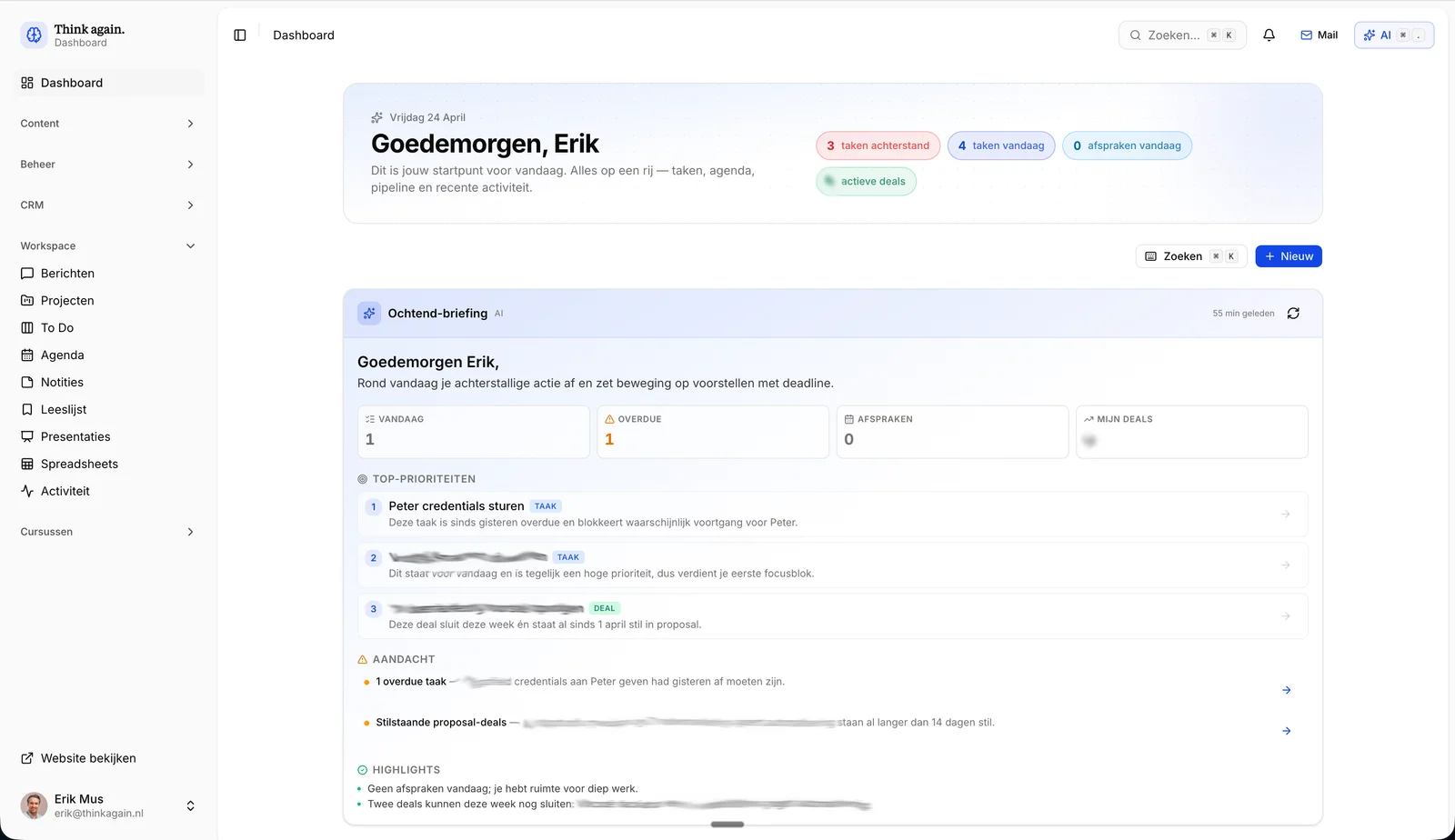
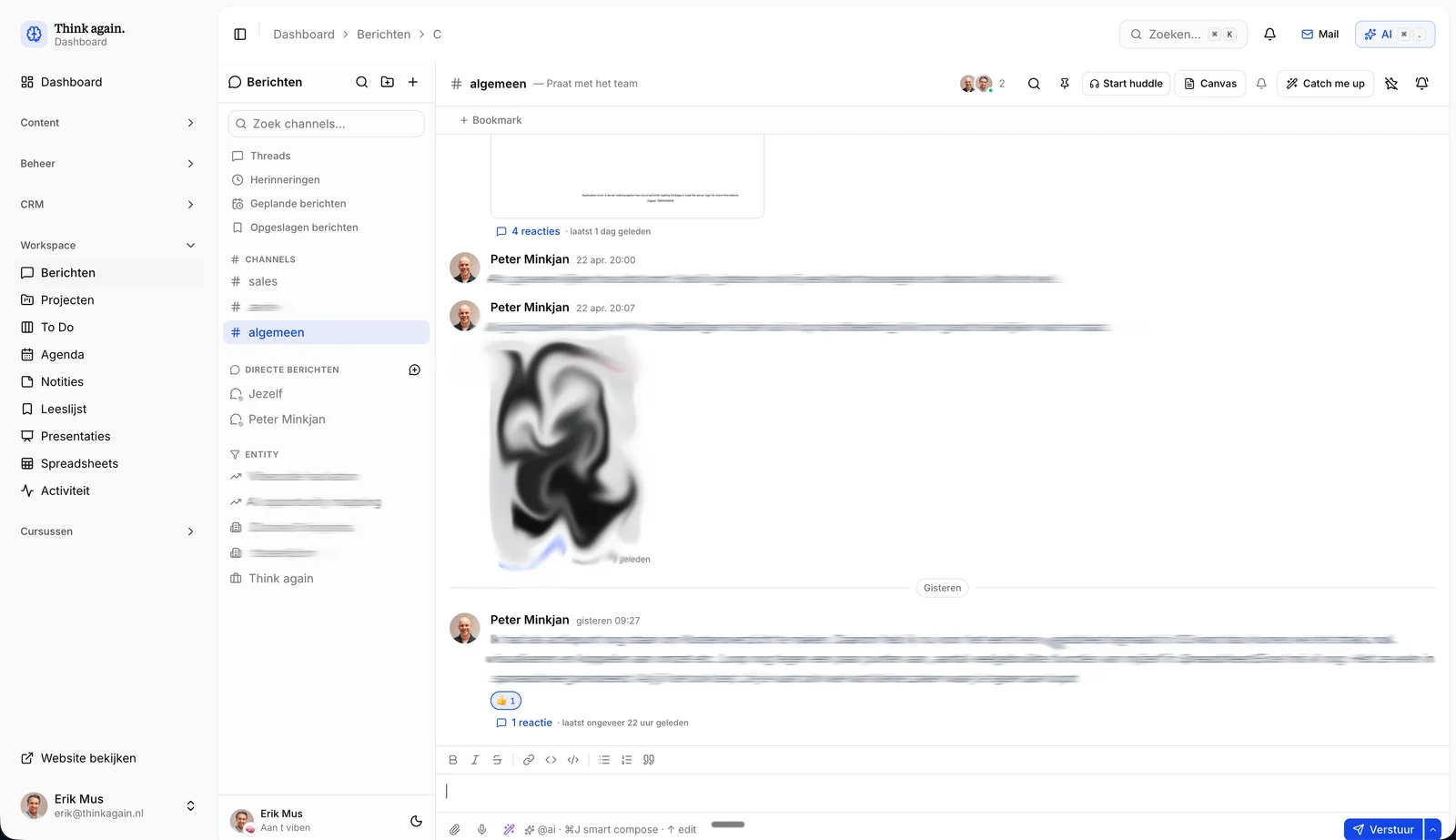
Our entire working day runs in a single dashboard. What's in it:
A CRM with pipeline, deals, companies, contacts, AI suggestions for follow-ups, and automatic enrichment via Clay-style features.
A CMS for our blog, with AI that helps write, suggests hooks, and automatically optimises the structure of every article for both Google and AI search engines.
A Slack alternative with channels, threads, voice notes, huddles, polls, reactions, scheduled messages — essentially every messaging feature you'd expect, plus a few that Slack doesn't have.
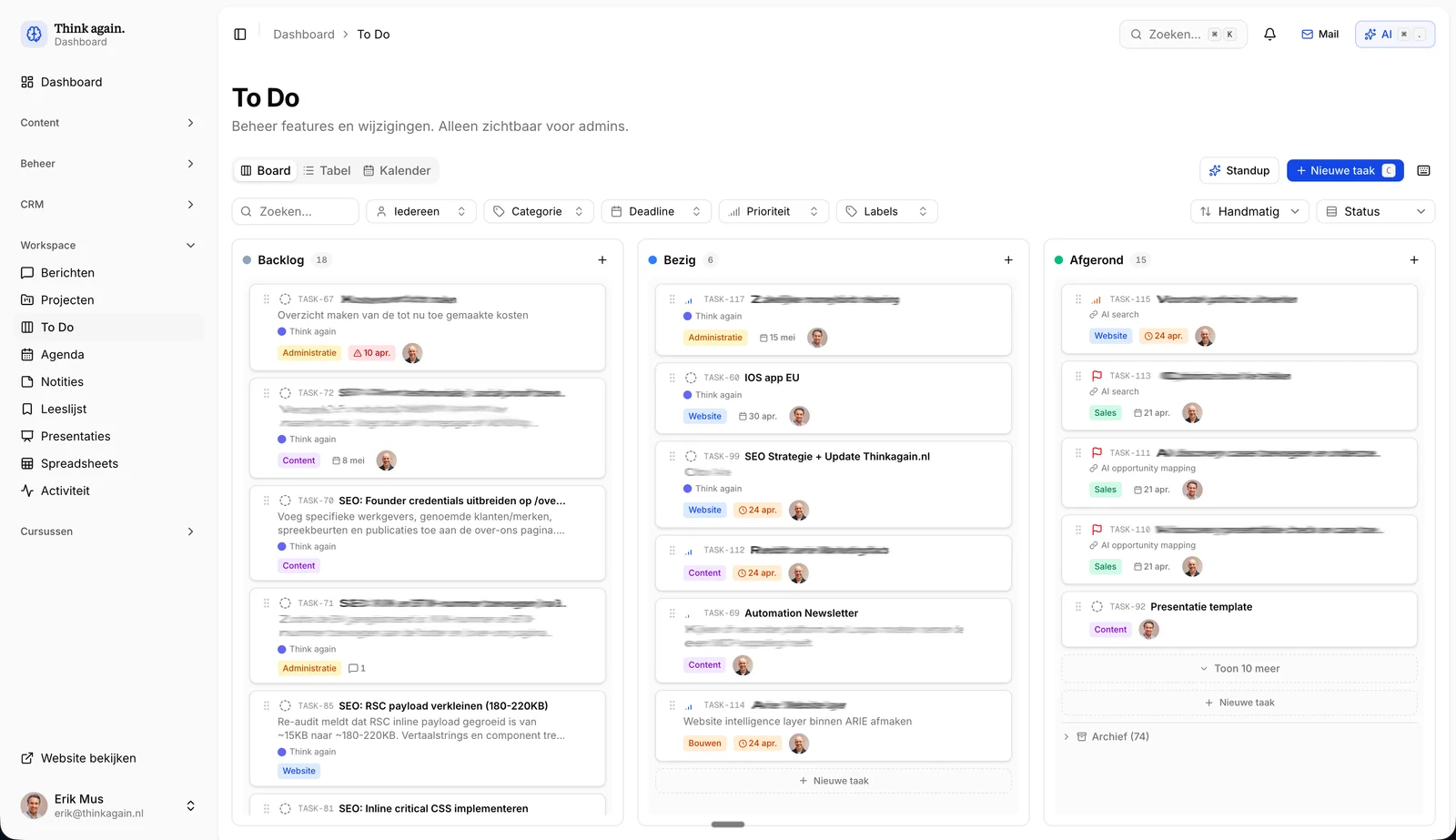
A Linear alternative for project management: kanban boards, sub-tasks, projects, deadlines, automatically linked to everyone involved in a deal or article.
A calendar that two-way syncs with Google Calendar. (Yes, we still find that sync genuinely useful, and our email is on Google too.)
A presentation builder that lets us generate decks (with AI integrations) without ever opening Google Slides or PowerPoint again.
A spreadsheet and document builder that completes our workspace as our Notion and Excel alternative.
A social media planner for LinkedIn, with AI that generates posts (currently as drafts) directly from a published article.
An e-learning platform for our clients (more on that another time).
A huddle feature for one-click audio calls with colleagues, in the same context as whatever you're discussing.
This isn't an MVP stack anymore. It's become a complete working environment we use every day, and it's already delivering significant advantages. Especially because we record our in-person meetings with our Plaud, have them transcribed, and then automatically converted by AI into summaries and to-dos inside our workspace.
That doesn't mean it's finished. Features like presentations and spreadsheets are genuinely complex, especially if you want to make them comparable to PowerPoint or Excel in both functionality and usability.
The advantage is that we keep improving it easily. Or, as I keep hearing Pieter Zwart (CEO of Dutch e-commerce company Coolblue) say in my head: "a little better every day." We take a screenshot, drop it into Cursor or Claude Code, explain what happened and what we hoped would happen. Nine out of ten times, it works after that.
Why we did this
Five years ago, this would have been madness. A consultancy building its own workspace? You should focus on your craft. Today, this is part of our craft.
The digital world has changed, and we believe we're only at the beginning of that shift. What used to take a team of five engineers a year now takes a small team a few months. When I started vibe-coding two years ago as someone who couldn't actually code, most of my time went into debugging. I rarely got anything properly working. Friends would half-jokingly ask whether it wasn't a waste of my time. Meanwhile, AI now writes the code. Designs the database. Does the code review. And catches bugs before they hit production.
Especially since Claude Opus 4.5 and the broader adoption of MCP, building software has become much more accessible. That doesn't mean someone starting tomorrow will have what we've built today within three weeks. But it does mean that anyone who can clearly articulate what they want to build can get remarkably far with the right tools and practice. Especially in combination with steadily improving LLMs like Claude Opus 4.7 and now ChatGPT 5.5.
This completely changes the traditional build-vs-buy calculation. The old choice was: build it yourself for hundreds of thousands of euros and years of work, or pay a few hundred a month for a SaaS tool. The new choice is: build it yourself for a fraction of the time and cost, with software that works exactly the way you want, or keep paying for a tool that never quite fits how you work.
What it actually delivers
The difference isn't just cost savings. It's what becomes possible when everything sits in one system:
A new lead from our contact form automatically becomes a deal in our CRM, with AI-generated background information, a first email draft, and a follow-up task on someone's kanban board.
An article we publish immediately generates a LinkedIn post draft, ready to publish under either a personal profile or our company page.
Our morning briefing combines calendar, open deals, and to-dos into a single AI summary. We even auto-generate the standup agenda based on who's attending.
Starting a huddle with a colleague takes one click, in the same context where the conversation is happening — no separate Zoom link to share first.
Our content engine sees which topics keep coming up in our pipeline and suggests articles that connect to them.
These are things that simply don't work with separate SaaS tools. Mostly because data can't flow freely through your organisation while it's sitting in ten different databases at ten different vendors. We have one database where all our information lives, and adding an AI layer on top of that creates real leverage.
What this means for your business
We're not building this because we want to become a software company — though that role will probably grow as the barrier keeps dropping. We're building it because it gives us insights we couldn't get anywhere else, and because we can only credibly tell our clients what AI does to their work if we're doing it ourselves.
The bigger lesson: in 2026, "we'll just buy a tool for that" is no longer the automatic right answer. For processes you use every hour, for data that runs through your entire organisation, for workflows that are unique to your business — that's where the SaaS route loses its economic edge. What you get back is a working environment that fits exactly how you work, instead of the other way around.
That doesn't mean everyone should build everything. It means the question needs to be asked again. And that "AI-first" isn't just about having a ChatGPT tab open. It's about redesigning how you work, how information flows, and how you use software as leverage rather than as a cost line.
We're happy to share how we built it, what worked, what didn't, and what we'd do differently. And we help companies think through what this could mean for them.
There's a good chance you got to this article because you saw it on LinkedIn. If so, consider this: the article was drafted by Claude Code — which knows exactly what our workspace can do — edited by me, translated into English by Think Again OS, and queued up as a LinkedIn draft. I spent half an hour on it, because the human touch genuinely matters. But if I'd had to do all of this by hand, it would have cost me half a day.