On 22 April, Anthropic published the results of an extensive study among 81,000 Claude users. The study consisted of open interviews about their hopes and concerns around AI. The researchers, Maxim Massenkoff and Saffron Huang, then used Claude itself to classify those free-form responses: occupation, career stage, productivity gain, and whether someone was worried about losing their job.
A few of the findings are directly relevant for any organisation currently thinking about AI adoption. Three of them deserve attention.
1. The people accelerating the fastest are the most afraid
The first chart in the report is the most important one. The x-axis shows "observed exposure", Anthropic's own measure of how many of the tasks within a profession Claude is already performing. The y-axis shows the percentage of respondents saying they fear losing their job to AI.
The line slopes upward. For every ten percentage points of additional exposure, job anxiety rises by 1.3 percentage points. Web developers, programmers and graphic designers sit at the top. Elementary school teachers, clergy and chemists at the bottom.
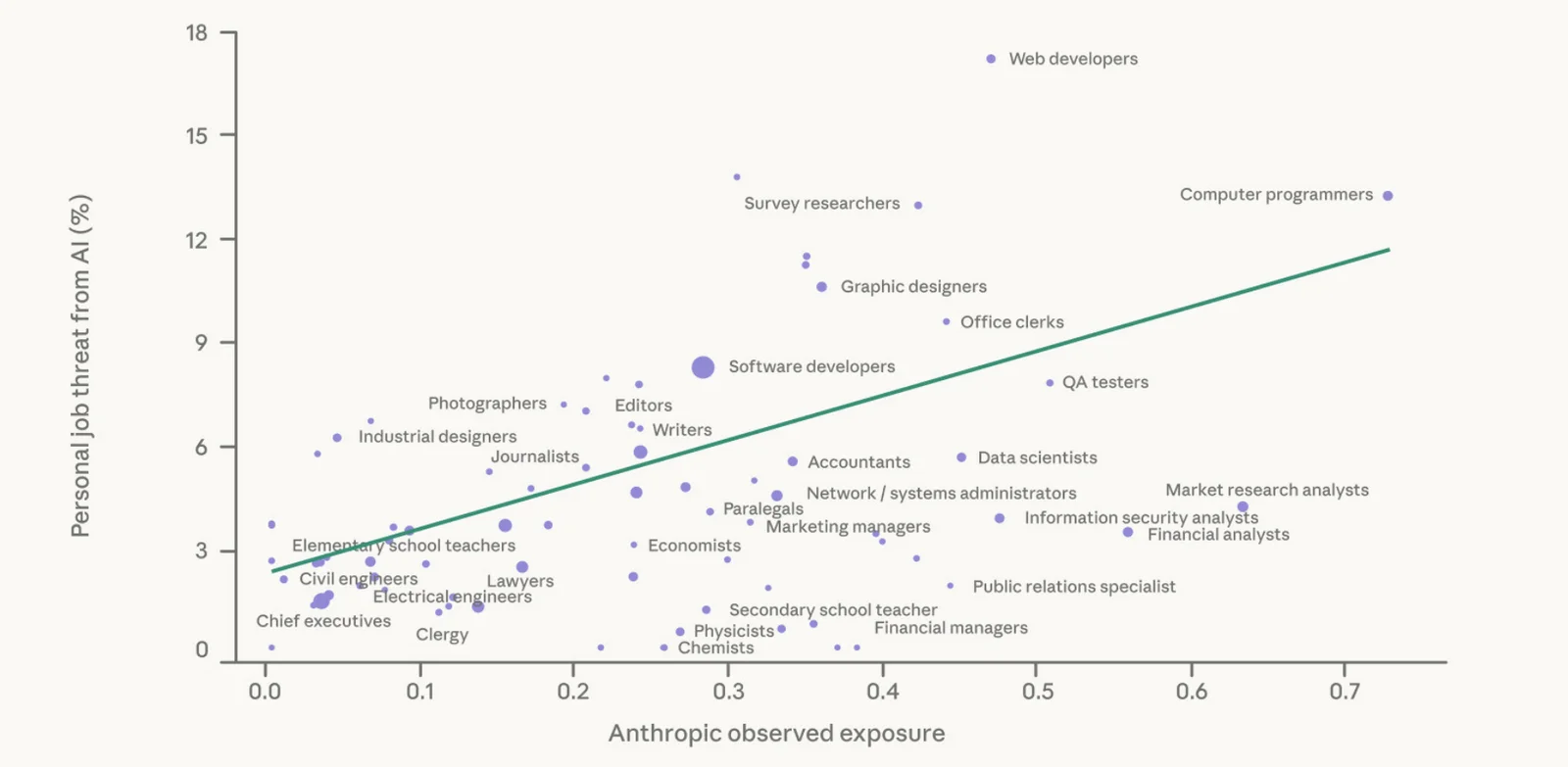
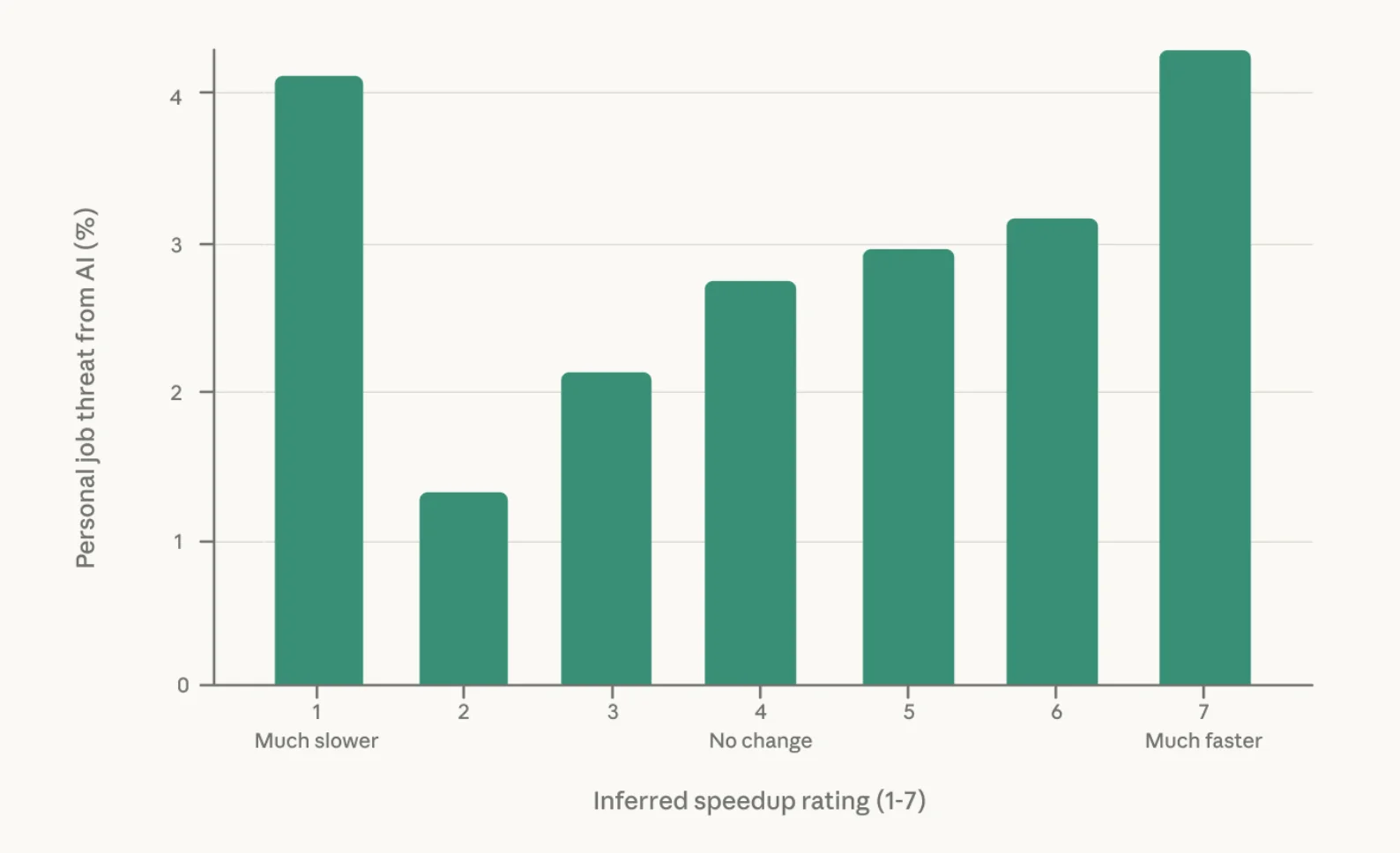
Figure 6 is also interesting. There the researchers measure not exposure but perceived acceleration: how much faster are you getting through your work thanks to AI? The relationship with job anxiety is U-shaped. People who say AI slows them down are uneasy, often creatives who find the tool too rigid but do see how the market around them is changing. But on the other end of the curve sit the people reporting that they now work dramatically faster. They are also afraid. And economically that makes sense: if the time required to do your tasks halves in a few quarters, the question of how long your role continues in its current form becomes urgent.
This is a pattern you are going to see emerge inside organisations. The power users, the people who pick it up enthusiastically and double their output, are not at the same time the most relaxed colleagues. They see sooner than others where things are heading, and may occasionally mention that they have had sleepless nights. At least, I recognise that strongly in myself and hear it regularly from active users around me.
2. The gains land at the extremes of the pay scale
The second finding concerns who becomes more productive. The researchers scored each answer on a scale from 1 to 7, where 1 stands for less productive and 7 for transformatively more productive.
Average score: 5.1. Substantially more productive, then. But the distribution is not flat. High earners (Q4) report the largest gains. Logical: software developers, managers, consultants. But Q1, the lowest quartile, also sits relatively high. A delivery driver using Claude to set up an e-commerce business. A landscaper building a music application. A customer service agent who can draft answers faster.
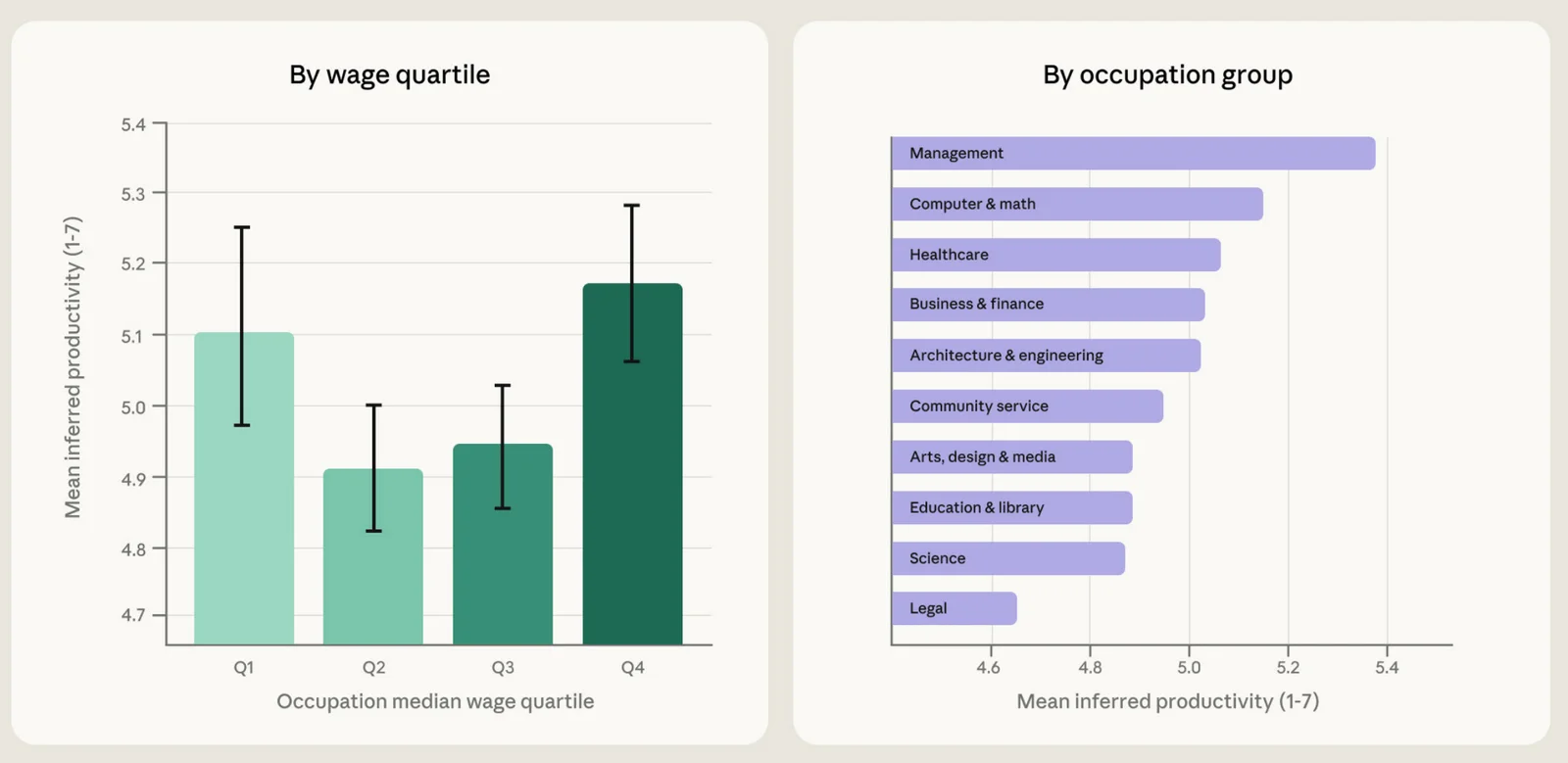
The middle (Q2 and Q3) reports the smallest gains. That is an uncomfortable pattern to see as an employer. The people who are well paid because they have a lot of expertise get an extra multiplier on top. The people at the bottom use AI to do things they previously could not afford, often outside of their jobs. And the large middle segment of knowledge work (legal, scientific, administrative) so far sees the smallest gains, sometimes because AI is not precise enough for their work, or because they do not yet know well enough what they can get out of it or how to use it.
The type of gain is also telling:
48 percent of respondents who mention productivity effects describe scope: doing things that were not possible before.
40 percent describe speed: the same work, faster.
12 percent mention quality.
2 percent mention cost.
AI, in other words, is mainly a capacity expander, not a replacement for input.
3. Early careers feel the pressure harder
The third finding is shorter but important. For about half of respondents, Claude could infer a career stage. Early-career workers report job anxiety more than twice as often as senior professionals (roughly 8 percent versus 4 percent). And where 80 percent of senior professionals say the gains from AI land with themselves, only 60 percent of early-career people say the same.
In other words: juniors feel that the productivity gain does not fully belong to them. Part of it goes to the employer, who expects more output, or to the client. That aligns with earlier Anthropic research, which found tentative signals of slowing hiring of entry-level workers in the United States.
What does this mean for organisations?
Three things.
One. When you introduce AI, look at the opportunities as a capacity expander. The data shows that the gains sit mainly in scope: people can do more. Communicate it that way. The alternative, framing it as "we are going to do the same work with fewer people", triggers exactly the anxiety that power users already feel, without accelerating adoption.
Two. Pay attention to your juniors. They feel more vulnerable, and they are right: the tasks through which you used to 'learn the trade' (summarising, drafting, basic analysis) are precisely the tasks a model takes over first. So think carefully about what their learning path looks like when the entry-level work is automated.
Three. Watch the middle segment. Q2 and Q3 in the data are the people who run the most risk while benefiting the least. This is because they often sit in roles where they simply do not have the space or knowledge to develop this. The biggest organisational task often sits here: not introducing the tool, but redesigning the role and freeing up space for later gains.
Source: Massenkoff, M. and Huang, S. (2026). What 81,000 people told us about the economics of AI. Anthropic, 22 April 2026.