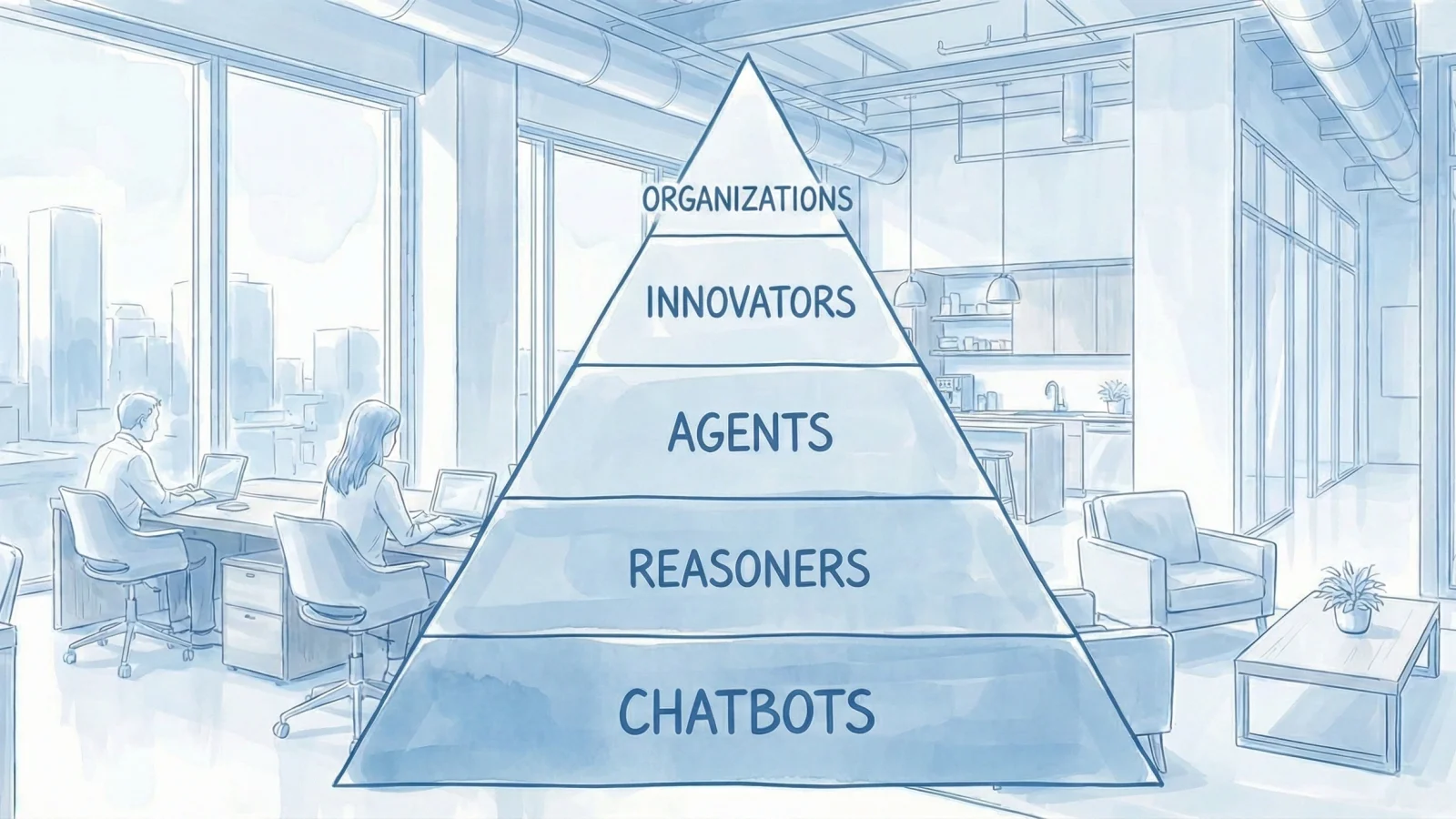
In July 2024, OpenAI introduced a framework that helps map the development of AI: five levels, ranging from simple chatbots to systems that can do the work of entire organizations. The framework is reminiscent of the five levels of autonomous driving and, as with self-driving cars, the devil is in the details of each level.
Let's go through each level. Not from the technology, but from the question that really matters:How does this specifically change how you do your work?
Level 1: Chatbots — “Ask a question, get an answer”
This is the level where most people first encountered AI. ChatGPT launched in late 2022 and the world discovered that you could ask a machine a question and get a pretty good answer back.
What it does for you:You can brainstorm, have texts written, make summaries, do translations. It's digital ping-pong where you hit by sending a message, AI hits back by replying.
The limitation:Every conversation starts from scratch. The AI doesn't really "think", but predicts the most likely next word. The result is often impressive, sometimes downright wrong and you have to discover the difference yourself. Due to the very credible but regularly incorrect answers, van Dale chose 'hallucinate' as word of the year.
In practice:Most marketers who say they are “using AI” are at this level. They type a prompt, get a text, and adjust it. That's fine, but it's the training wheel bicycle of AI use.
Level 2: Reasoners — “Ask a question, let AI think for a moment, get an answer”
Here's where it gets interesting. Reasoning models, such as OpenAI's o1 series and Claude with extended thinking, can parse a problem before answering. They "think": they formulate hypotheses, test assumptions and correct themselves.
What it does for you:You can ask more complex questions. Not just "write a text about X" but "analyze these three competitors, compare their positioning and advise which hook is best for us to choose." The model reasons step by step and comes to a substantiated conclusion.
The limitation:The model still only does what you ask. It doesn't have access to your inbox, your CRM, or your project management software. It can reason brilliantly about the information you give it, but it does not search independently.
In practice:This is the level where thequalityof your prompts really matter. Anyone who can properly instruct a reasoning model can extract strategic advice from it that previously could have taken days in minutes. Anyone who treats it as a chatbot misses the whole point and therefore the added value compared to level 1.
Where are we now?Most people are here. They're sniffing at Level 2. By early 2025, the best models will be operating firmly at Level 2. Reasoning has been the big leap of the past year. But most users do not use it yet, they use a Ferrari to do their shopping at the local supermarket around the corner.
Level 3: Agents — "I'll handle it"
This is the level the industry is moving to now, and where the hype is the greatest. An AI agent not only responds to your input, it takes action independently. He can visit websites, fill out forms, send emails, edit files, and perform multiple steps in succession to achieve a goal.
What it does for you:Instead of “write a social media post,” say, “Publish three LinkedIn posts this week based on our latest whitepaper, schedule them, and report the engagement numbers at the end of the week.” The agent plans, executes, and reports.
The limitation:Agents are powerful but vulnerable. They sometimes interpret goals differently than intended, make mistakes that a human would immediately recognize, and still require regular human supervision. The Washington Post tested OpenAI's Operator agent with the task of finding the cheapest eggs, and the result was an unwanted $31 Instacart delivery package on the doorstep. Promising, but not yet reliable enough to blindly trust and thus give full access to your social media channels.
In practice:We see the first real agent products appearing. ChatGPT's Agent Mode, Claude Code and Cowork, Manus, Cursor, Copilot Studio and Openclaw. They can run impressive workflows. But let's be honest: most companies are really not ready for this yet. Not because the technology does not work, but because their processes, data and work structures are not designed for it. You can't unleash an agent on a chaos of spreadsheets and undocumented processes. The only exception to this isClaude Cowork, which knows better than anyone else how to independently navigate your way through your documents, the web and the task you have given, making it a good way to take the step to level 3.
Level 4: Innovators — “I have an idea”
At this level, AI contributes to actual innovation. Not by reordering existing knowledge (it already does that), but by arriving at original solutions, discoveries and inventions. Think of an AI that designs a new molecule, formulates a scientific hypothesis, or comes up with a completely new marketing strategy that no human has ever thought of before.
What it would do for you:AI becomes a creative partner that not only executes, but also provides direction. It comes up with campaign concepts that are really new, discovers patterns in your data that no one saw, or proposes a go-to-market strategy that radically deviates from convention.
The limitation:We're not here yet. And the honest question is whether we will recognize this stage when it comes. Innovation is difficult to define and even more difficult to measure. When is an AI-generated idea truly original (many people argue that AI is not and cannot be creative), and when is it a clever remix of what it has seen before?
In practice:There are promising signals. OpenAI reported that GPT-5 made a laboratory molecular cloning process dramatically more efficient. But for marketing and knowledge work, this level is still largely in the future.
Level 5: Organizations — “I run the place”
The end point of the framework: AI that can do the work of an entire organization. Determining strategy, coordinating work flows, making decisions, managing projects. Everything from CEO to intern.
What it would do for you:Honestly? This is the level where "doing it for you" ceases to make sense. If AI can run an entire organization, the question shifts from “how do I use AI?” to "what is my role anymore?" After all, it is better than you at every step.
The limitation:This is science fiction, not science. No AI system even comes close to this. And the ethical, legal and social questions that this level raises are at least as complex as the technical challenges.
What really matters
Frameworks are useful, but dangerous if you take them too literally. Reality is messier than five neat levels. In practice, most teams use AI at level 1, while the technology is ready for level 2, and level 3 is also becoming increasingly available and accessible.
That gap between what the technology can do and what organizations do with it is exactly where the greatest opportunity lies. Not in chasing the latest agent tool, but in systematically scaling how you and your team work with AI. AI is much more than a tool. It is a technology that, when used correctly, drastically changes the way you work and makes you more productive.
Our recommendation:
Stop dreaming about level 5, don't think that you have to create an agent for everything because management calls for it. Start by mastering level 2, then 3 and so on. Teach yourself and your team to work with reasoning models. Invest in prompting skills, not as a gimmick but as a core competency. This is not so much about the structure of how you say something, but much more about providing sufficient context, so that AI can really show its added value. Document your processes so that you are ready for agents, regardless of what form they come in. And above all: think critically about what problem you are actually solving before choosing an AI solution.
The companies that will make the difference are not the ones that adopt the latest tool the fastest. It is the companies that best understand what each level of AI can do for their specific work and work methodically towards that.
It is not a race to level 5. It is a journey through each level, where it is no problem if you do not know in which level you are operating, as long as you know your way up step by step.