Loading...
How artificial intelligence went from trick to transformation in two hundred years and why the last three years changed everything
 EM
EMWe only email you when we have something worth sharing.
Don't worry, we hate spam just as much as you do.
Picture this: it's November 2022. You're sitting at your desk and typing a question into a chat window.“Write a blog post about sustainable travel.”Within ten seconds, text appears that, while not perfect, is better than what many people would produce in half an hour. You frown. You lean back. You vaguely realize that something fundamental has shifted, but you cannot yet comprehend how fundamental.
That moment was the launch of ChatGPT. It was the starting signal of what we now know as the AI revolution. But it wasn't the beginning of the story. That started more than two hundred years earlier, with a wooden box, a chessboard and a clever illusion.
This article tells the story of artificial intelligence from its very first trick to its most recent breakthrough. Not as a dry overview of history, but as a journey that shows how unimaginably fast things are going now. Every time you think “okay, now I get it”, the technology has already advanced three steps. What was science fiction a year ago is a feature today. What was a demo yesterday is a product tomorrow.
If you're reading this and thinking “I'm behind”: that's okay. Everyone is behind. The point is that you start catching up.
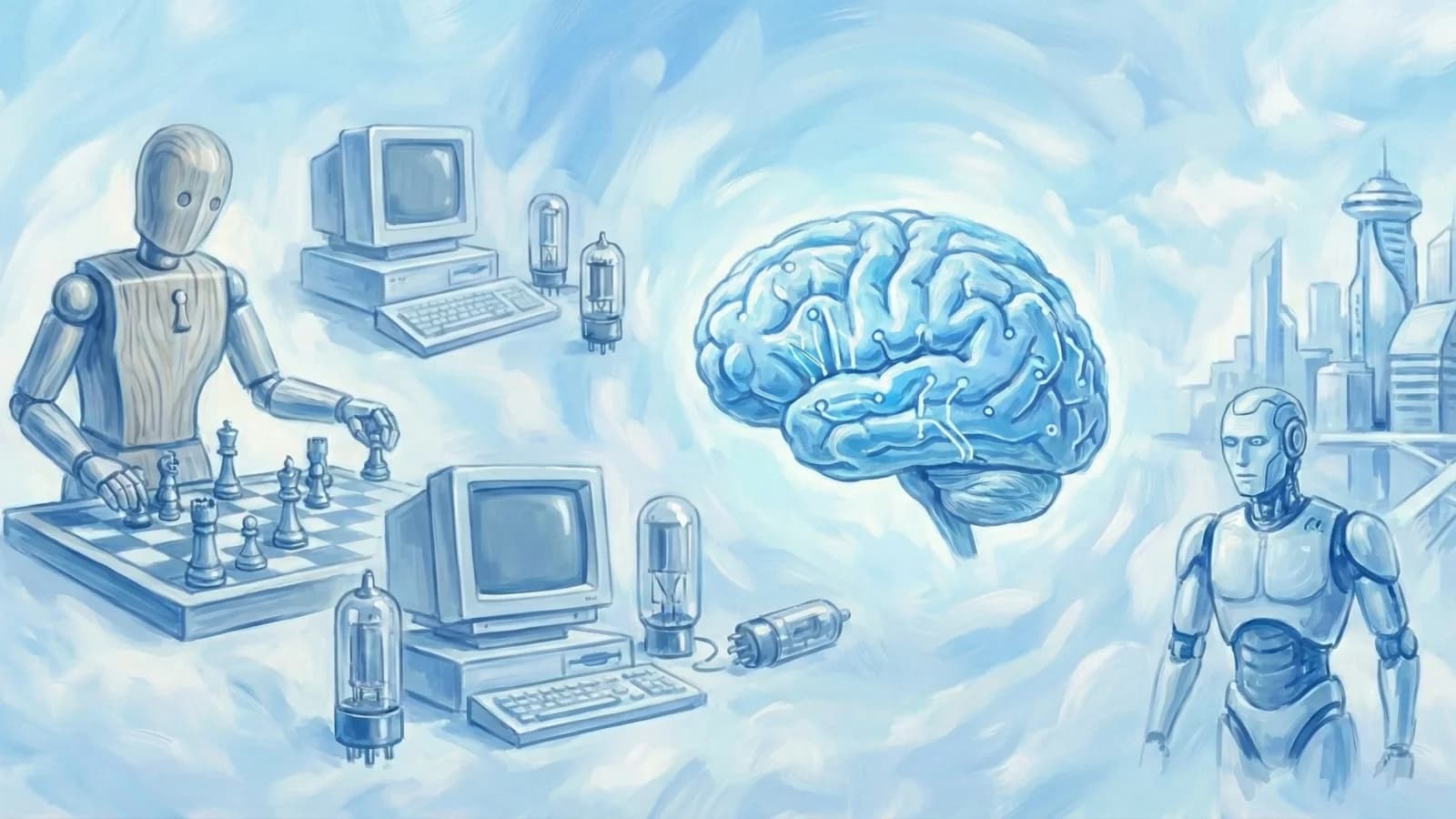
In 1770, the Hungarian inventor Wolfgang von Kempelen presented a machine to the court of Empress Maria Theresa: a wooden cabinet with a chessboard on it and a doll in Ottoman clothing behind it. The “Mechanical Turk” could play chess and beat almost everyone, including Napoleon Bonaparte and Benjamin Franklin.
It was a sensation. People really believed that this machine could think. The truth was more prosaic: hidden inside the cupboard was a small, highly skilled human chess player. The Mechanical Turk was not an artificial intelligence. It was a clever trick.
But the dream it represented, a machine that could think like a human, would never go away. It took almost two centuries before anyone started working on it seriously.
In 1950, British mathematician Alan Turing published a paper with a seemingly simple question:Can machines think?Instead of answering that question directly, he suggested a test. If a human cannot distinguish through a text conversation whether he is talking to a human or a machine, then you can call the machine “intelligent”.
The Turing Test became the reference point for decades of AI research. The brilliance of it was that Turing didn't define what intelligence is, he defined when it no longer matters. If it looks like thinking, sounds like thinking, and acts like thinking, who cares if it is “real” thinking?
Turing would have celebrated his 112th birthday in 2024. He died in 1954, long before he even came close to passing his test. But his question propelled the entire field forward.
After Turing's provocation, a wave of optimism broke out. In 1956, researchers at Dartmouth College organized a summer conference where the term “artificial intelligence” was officially born. The expectation was that machines would reach human levels within a generation.
That didn't happen. The first decades of AI research were marked by great promise and disappointing results. Computers could solve simple logic puzzles, but failed miserably at anything involving language, visuals, or common sense. Governments withdrew funding. Researchers lost their jobs. This was called the first “AI winter,” a period of disillusionment that lasted well into the 1980s.
On May 11, 1997, what had long been thought impossible happened: IBM's supercomputer Deep Blue defeated chess world champion Garry Kasparov in an official match. It was world news. The front page of every newspaper. The machine had defeated man, at least in chess.
In retrospect, Deep Blue was a fascinating deception. The computer was not “intelligent” in any meaningful sense. He could evaluate 200 million chess positions per second, but could not hold a conversation, understand a joke, or pour a cup of coffee. Deep Blue was lightning-fast “brute force” power without understanding.
But like the Mechanical Turk, Deep Blue shifted the overton window of what machines could do. If they could beat the best chess player in the world… what else was possible?
While the general public briefly forgot that AI existed after Deep Blue, something crucial happened behind the scenes. Researchers discovered that neural networks, separate mathematical models inspired by the workings of the brain, became spectacularly good if you fed them with enough data and computing power.
In 2012, a neural network called AlexNet won an image recognition competition with such a large lead over the competition that the field collectively changed course. Suddenly a computer could tell a cat from a dog not by programmed rules, but by “seeing” millions of examples.
This was the deep learning revolution, and it laid the foundation for everything that would follow. Google, Facebook, Microsoft and Amazon started investing billions. The second AI winter was finally over.
In 2017, Google researchers published a paper with the modest titleAttention Is All You Need.It introduced a new architecture for neural networks: the Transformer. The name sounded like a Hollywood movie, but the impact was more real than any blockbuster.
The Transformer made it possible to process enormous amounts of text and find patterns in them much faster and more effectively than previous methods. It was the foundation on which GPT, BERT, and later all major language models were built. Without that 2017 paper, there would have been no ChatGPT.
Founded in 2015 by Elon Musk and Sam Altman, among others, OpenAI began building increasingly large language models based on the Transformer architecture. GPT-1 (2018) was able to complete simple sentences. GPT-2 (2019) already wrote compelling paragraphs so convincing that OpenAI initially refused to release the model for fear of misuse.
GPT-3, released in 2020, was a watershed. Met 175 miljard parameters kon het essays schrijven, code genereren, vertalen en vragen beantwoorden. Developers started building tools with it. But for the general public it remained abstract. You had to request an API and be technically savvy to work with it.
The world needed a spark to see what was possible. That spark came on November 30, 2022.
ChatGPT wasn't technically revolutionary, it was GPT-3.5 with a chat interface around it. But that interface made the difference. Suddenly anyone, without any technical knowledge, could have a conversation with an AI. It was like discovering the Internet for the first time: you knew it existed, but you had no idea how big it was.
Within five days, ChatGPT had one million users. One hundred million within two months. The fastest adoption of any technology in history. Faster than the iPhone. Faster than TikTok. Faster than the internet itself.
The reaction was a mix of euphoria and panic. Students used it for papers. Programmers made it write code. Marketers generated content. Teachers discovered that they could no longer detect plagiarism. And the same question was heard everywhere:“What does this mean for my job?”
Google, which had invented the Transformer architecture itself, was completely surprised by the success of ChatGPT. In March 2023, it hastily launched Google Bard. A direct competitor based on their own LaMDA model. The launch was messy: in a promotional video, Bard gave a factually incorrect answer about the James Webb telescope, which cost Alphabet ten percent in market value.
It was a sign of the times. Companies that had been working methodically on AI for years suddenly felt the hot breath of OpenAI on their necks. The AI arms race had begun. Microsoft invested billions in OpenAI. Google restructured its AI teams. Meta went all-in on open source. Amazon, Apple, everyone rushed to the table.
In March 2023, OpenAI released GPT-4, and the difference from its predecessor was shocking. The model could not only process text, but also interpret images. It scored in the top ten percent on the American bar exam. It could write complex code, analyze scientific papers, and write creatively at a level that made many people uncomfortable.
For the first time, the Turing Test, Turing's old thought experiment from 1950, started to feel relevant in the real world. Not as a formal experiment, but as a daily experience: increasingly you could no longer tell whether a text had been written by a human or a machine.
While language models turned the text world upside down, image generators underwent their own evolution. And that evolution was inadvertently documented by two informal “benchmarks” that captured the collective memory of the Internet.
The Otter by Ethan Mollick.Wharton professor Ethan Mollick was on a plane with his teenage daughter in 2022. The WiFi didn't work. Otters were her favorite animal. He typed the prompt “otter on a plane using wifi” into Midjourney and posted the result to X. It went viral.
From then on, Mollick repeated the same prompt with each new version of each image generator. The results tell the story better than any benchmark report. In October 2022, Midjourney v3 produced a blur that vaguely resembled an otter. In November 2022 (v4) it was recognizable as an otter, but with a weird keyboard and too many fingers. In March 2023 (v5) it was photorealistic. In 2024, it became almost indistinguishable from a real photo. In early 2025, Mollick officially declared the test “obsolete.” It had become too easy for all the image generators. He switched to video.
Will Smith and the spaghetti.In March 2023, a Reddit user posted a video made with ModelScope's text-to-video tool: “Will Smith eating spaghetti.” The result was hilariously bad. Smith's face melted between frames, his hands turned into rubber appendages, and the spaghetti floated as if it had physics of its own.
The video became a meme but also a measuring stick. Every time a new video model came out, the first question was, “Can it make Will Smith eat spaghetti?” In 2024, China's MiniMax produced a recognizable version, but the chewing was wrong. In May 2025, Google's Veo 3 almost succeeded, but the noodles sounded too crunchy. By October 2025 with Veo 3.1 it was virtually indistinguishable from the real thing. In early 2026, with Kling 3.0, Will Smith sits at the table talking while eating spaghetti, complete with sound and emotion.
From grotesque distortion to film quality. In less than three years.
If 2023 was the year of “wow, this exists,” then 2024 was the year of “wait, it keeps getting better.” The major AI labs were rapidly releasing new models, each more powerful than the last. Claude from Anthropic, Gemini from Google, Llama from Meta, the market exploded.
But the real shift in 2024 was conceptual. OpenAI introduced its o1 model, the first “reasoning model.” Instead of giving an immediate answer, o1 thought first, sometimes hundreds of words of internal “chain of thought”, before responding. It was as if the AI learned for the first time to be quiet and think before it spoke.
The difference was noticeable. Complex math problems, logic puzzles, programming problems. Reasoning models performed dramatically better than their predecessors. It was the beginning of what some have come to call the “reasoning era.”
Meanwhile, AI shifted from “thing you chat with” to “thing that does work for you.” GitHub Copilot helped programmers write code. Cursor built a complete development environment around AI. Canva integrated image generation. Notion got AI writing help. Every SaaS product you knew suddenly got an AI button.
And it got personal. I, someone with no programming experience, built a complete YouTube SEO tool with AI in 2024. I builtwinterkaart.com, a functioning website, purely by describing what I wanted. Not a line of code written by myself. The threshold for creating something had not been lowered, it had disappeared.
A telling detail from 2024: the benchmarks we use to measure AI began to break down. In 2023, MMMU, GPQA and SWE bench were introduced to test the limits of AI systems. A year later, scores on these tests had increased by 18.8, 48.9 and 67.3 percentage points, respectively. Tests that were meant to last for years became obsolete within months.
This is perhaps the most powerful evidence of exponential progress: we can't even come up with new tests fast enough to keep up with how quickly AI is improving.
On January 20, 2025, something happened that no one could have seen coming. The Chinese company DeepSeek, until then virtually unknown in the West, released R1, a reasoning model that performed equivalent to OpenAI's o1 on most benchmarks. That in itself was remarkable. But the shocking part was the cost: DeepSeek claimed to have trained the model for about $6 million. By comparison, Western labs spent hundreds of millions on similar models.
The market reaction was immediate and brutal. On Monday, January 27, chip manufacturer Nvidia lost almost $600 billion in market value in one day. The largest single-day loss in history. The logic was simple: if a Chinese lab could build frontier AI at a fraction of the cost, what was the value of all those expensive GPU clusters?
DeepSeek became AI's “Sputnik moment.” It proved three things at once: China wasn't as far behind as thought, algorithmic smarts could compensate for hardware limitations, and the assumption that better AI always costs more money was wrong. The model was also open source, so anyone could work with it. The entire industry had to rethink its strategy.
After DeepSeek, 2025 became the year in which reasoning models became the norm. OpenAI released GPT-5 in August, which many say completed the shift from “chat AI” to “think AI.” Google DeepMind's Gemini Pro won gold at the International Mathematical Olympiad. Anthropic released Claude Opus 4.5, which could process entire books with a context window of one million tokens.
Not only could reasoning models solve math problems, they also began to perform on tasks previously considered exclusively human. Google DeepMind reported that their Gemini Pro reasoning model had helped to speed up the training process of Gemini Pro itself. AI that improves itself, modest improvements, but exactly the type of self-improvement that some researchers are both excited and concerned about.
Perhaps the biggest conceptual shift of 2025 was the transition from “chat” to “agent.” Instead of just responding to questions, AI systems began to perform tasks on their own. This was called “agentic AI,” and it fundamentally changed the way we think about AI.
In February 2025, Anthropic launched Claude Code, a tool that allowed developers to delegate tasks to Claude directly from their terminal. Claude Code could open files, write and run code, run tests, and even manage sub-agents for specific sub-tasks. Within six months it grew from a research preview to a product with a billion dollars in annualized sales and now even fourteen billion dollars in early 2026.
But Claude Code was just the beginning. AI agents were appearing everywhere that could not only talk, but also do things. Agents who could manage your email. Agents who could investigate. Agents who could write, test and deploy code. The line between “assistant” and “colleague” began to blur.
One of the most underestimated developments of 2025 was how human language models started to sound. Not only in the quality of their text, which was already good, but in their ability to understand nuance, context and style.
Claude learned to write in the tone you wanted. Not as a generic “professional” or “casual” style, but tailored to you. It remembered preferences from previous conversations. It could write an email that sounded like you wrote it. It could pick up on the subtleties of an internal corporate culture and act on them.
This was not just a technical improvement, it was a psychological barrier that was broken. As long as AI text felt like “AI text,” you could ignore it. But when it becomes indistinguishable from human communication, everything changes. Because did you realize that this article was also written for 99% by AI? At least not me while I'm minimally editing it. The Turing Test, Turing's thought experiment from 1950, was not formally passed in 2025, but informally, daily, by millions of users.
As AI agents became more capable, a clear pattern began to emerge. Tasks that previously required specialized software - project management, CRM, document management, data analysis - could increasingly be handled by an AI agent. Not always good, not always reliable, but the direction was unmistakable.
In the tech industry, this phenomenon was given a name: the SaaSpocalypse. The fear that artificial intelligence, especially agentic AI, poses an existential threat to the hundreds of billions of dollars of Software-as-a-Service companies built over the past fifteen years. Why pay for ten different subscriptions when one AI agent can perform the same tasks?
The term is deliberately exaggerated, not all software will become obsolete tomorrow, but the underlying point is serious. The value proposition of many SaaS products is shifting. It is not the software itself that is still the bottleneck, but the data and workflows surrounding it. Companies that understand this survive. Companies that think they are safe because their software is “indispensable” may be in for surprises.
On January 12, 2026, Anthropic launched Claude Cowork and it was as if someone threw open the door that until then had only been ajar. Cowork is what Anthropic describes as “Claude Code for the rest of your work.” It takes the agentic capabilities of Claude Code, opening, editing, creating files, and performing tasks independently and packages them into an interface that requires no technical knowledge.
You give Claude access to a folder on your computer. Then you can say, “Sort my downloads and rename everything logically.” Or: “Make a spreadsheet of this stack of receipts.” Or: “Write a first draft of this report based on my loose notes.” Claude makes a plan, executes it, and keeps you informed of progress. Less chatting back and forth, more like leaving a message for a colleague.
The impact was felt immediately. Legal software companies saw their shares plummet when it emerged that Cowork could consolidate court files. The S&P 500 software and services index lost $830 billion in value in six trading days. The Motley Fool called Cowork “the DeepSeek moment for software.”
Is that an exaggeration? Maybe. Cowork is another research preview with rough edges. But the signal is clear: the distance between “AI can theoretically do your job” and “AI actually does your job” is closing every month.
As I write this together with Claude Opus 4.6, on February 13, 2026, the state of affairs is as follows. 95 percent of professionals use AI at work or at home, according to the State of AI Report 2025. 76 percent pay for it out of pocket. 44 percent of American companies pay for AI tools, up from 5 percent in 2023.
Claude Cowork has just been released on Windows, with full feature parity with macOS. It has gained plugins that allow you to customize it for specific workflows and teams. Anthropic's valuation is estimated at $380 billion.
And this is just the beginning. Claude Code was built in a week and a half, largely by Claude Code himself. AI builds itself. Not in the science fiction sense of a machine becoming aware of itself, but in the very practical sense of software that makes software that makes software.
There's a reason why people have a hard time grasping how quickly AI is developing. Our brains are built for linear thinking. If something gets ten percent better every year, we can follow that intuitively. Maar AI verbetert niet lineair, het verbetert exponentieel. And exponential growth feels like a near standstill for a long time, until suddenly it feels like an explosion.
Consider this: there were 227 years between Mechanical Turk (1770) and Deep Blue (1997). There were 25 years between Deep Blue and ChatGPT. There was a year and a half between GPT-4 and the first reasoning models. Less than a year passed between the inception of agentic AI and a product that shook the software market.
The intervals become shorter. The jumps are getting bigger. And the pace continues to accelerate.
In the midst of all these technological earthquakes, it's easy to make two mistakes. The first is denial: pretending that nothing is happening because the technology is “not yet perfect”. The second is panic: thinking that everything will change tomorrow and that human skills will become worthless.
The reality is more nuanced. AI is incredibly good at some things and surprisingly bad at others. It can write a report, but it cannot determine whether that report supports the right strategic choice. It can generate code, but it can't sense the corporate culture that determines whether a product will be successful. It can analyze data, but it can't navigate the political dynamics in a boardroom.
What does change is the basic skills expected of people. Just as you can no longer say “I can't drive” in most professions today, “I don't work with AI” will become less and less acceptable. Not because AI replaces you, but because people who do work with AI simply get more done.
If the past three years have proven anything, it's that predictions about AI are almost always too conservative. Virtually no one predicted ChatGPT's explosive adoption. Almost no one predicted DeepSeek. Virtually no one predicted that a research preview of an AI desktop agent would cost the software market hundreds of billions.
What we do know: investment is accelerating. The Magnificent Seven tech companies collectively plan $680 billion in AI-related capital expenditures. The models are getting better. The agents become more capable. The tools become more accessible. And the line between what AI can do and what only humans can do is shifting every month.
The question is not whether AI will change your work. The question is whether you are there when it happens.
1770— The Mechanical Turk pretends that a machine can play chess
1950— Alan Turing publishes “Computing Machinery and Intelligence” and proposes the Turing Test
1956— Dartmouth conference: the term “artificial intelligence” is born
1997— IBM's Deep Blue defeats chess world champion Garry Kasparov
2012— AlexNet wins ImageNet and ushers in the deep learning revolution
2017— Google publishes “Attention Is All You Need” — the Transformer architecture is born
2018— OpenAI releases GPT-1
2020— GPT-3 (175 billion parameters) shows the power of large language models
Nov 2022— ChatGPT launches and reaches 100 million users in two months
Mar 2023— GPT-4 launches; Google releases Bard; first AI video models produce hilariously bad Will Smith spaghetti
2023–2024— Midjourney, DALL·E and Stable Diffusion make image generation mainstream; Ethan Mollick's otter test becomes too easy
Sep 2024— OpenAI introduces o1, the first reasoning model
Jan 2025— DeepSeek R1 shocks the world; Nvidia loses 600 billion in one day
Feb 2025— Anthropic launches Claude Code
May 2025— Google's Veo 3 almost passes the Will Smith spaghetti test; Sora 2 launches
Aug 2025— OpenAI releases GPT-5
Sep 2025— Claude gains persistent memory
Oct 2025— Veo 3.1 creates nearly realistic video; Nvidia reaches $5 trillion market cap
Jan 2026— Claude Cowork launches and is called “the DeepSeek moment for software”.
Feb 2026— Cowork gets plugins and Windows support; Anthropic valued at $350 billion
EMErik has been working in marketing since 2012. What started as an all-round marketer evolved through brand activations, YouTube and social media, advertising to an ever-growing fascination with how platforms work and how they keep changing. That fascination has only grown now that AI is fundamentally changing the landscape: how people orient themselves and how you do your work by using AI smartly. Erik now builds complete apps and systems with AI tools like Claude Code and Cursor, without writing a single line of code.